

The European adder (Vipera berus) is Finland’s only venomous snake and lives across almost the whole country, including Ostrobothnia. Bites happen mainly from April to September, while adders are out of hibernation; in spring and autumn they often bask in the open on sunny slopes near their winter dens. Dogs are bitten most often because they sniff and paw at snakes, so most bites are on the head, muzzle or legs. Cats can be bitten too. An adder bite is always a veterinary emergency.
Symptoms
Swelling usually starts quickly, often within minutes. Other signs develop over hours, and heart rhythm problems can appear within hours or up to about two days after the bite. Local signs: fast-spreading, painful swelling, bruising, and sometimes one or two small puncture marks, often hidden by fur. General signs: dullness, weakness, drooling, vomiting, fast breathing and a racing heart. Serious signs: collapse, pale gums, bleeding from the bite or widespread bruising, and an irregular heartbeat. Swelling of the head and neck, and bites to the mouth or tongue, can narrow the airway. A pet that seems better can still get worse.
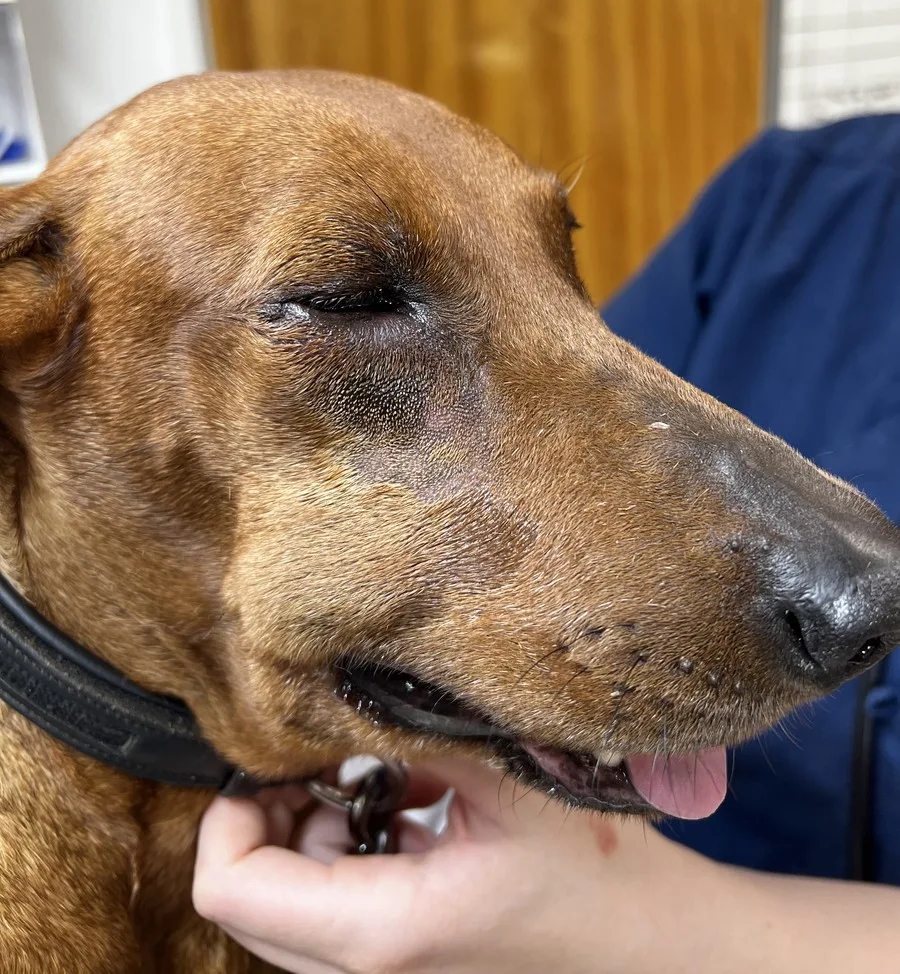
First Aid
Call a vet straight away, even if your pet seems fine: Eläinklinikka Saari on (06) 321 7300 or, after hours, the Vaasa vet emergency line on 0600 399 299. If you are not sure whether it was a snake or a wasp, call anyway. Note the time of the bite. Keep your pet calm and still: carry a small dog, and let a large one walk slowly. Take off the collar if the head or neck is swelling. If breathing becomes difficult, go to the nearest vet at once and call on the way. Do not cut or suck the bite, put ice on it or apply a tourniquet. Do not give human painkillers. Do not give “adder tablets” (cortisone) unless a vet tells you to — they do not treat the venom and take hours to work. Leave the snake alone; adders are protected in Finland.
Veterinary Treatment
Treatment includes intravenous fluids, strong pain relief (usually an opioid) and close monitoring for at least 24 hours, often longer. Monitoring includes an ECG to check heart rhythm and blood tests for blood count, clotting, and kidney, liver and muscle values. Antivenom binds venom that is still in the body; in one large study, swelling went down about twice as fast in dogs given antivenom. The vet uses it in moderate to severe cases, ideally early. Our clinic has adder antivenom available. Anti-inflammatory painkillers are avoided, and cortisone is not given routinely because a trial in dogs showed no benefit. Most dogs go home within a day or two and recover fully; the swelling settles over a few days. In larger studies, about 3–5 % of bitten dogs died.
Prevention
Keep your dog on a leash in adder habitat: sunny rocky outcrops, forest edges, clearings, meadows and bog margins, especially in spring and autumn sunshine. Stay on paths and don’t let your dog nose into stone piles or undergrowth. Adders are shy and bite only when surprised or disturbed. Treat every bite as an emergency, even if your dog has been bitten before.
Sources
- Lervik J.B., Lilliehöök I., Frendin J.H.M. (2010): Clinical and biochemical changes in 53 Swedish dogs bitten by the European adder – Vipera berus. Acta Veterinaria Scandinavica 52:26. pmc.ncbi.nlm.nih.gov/PMC2873270
- Brandeker E. ym. (2015): The effect of a single dose of prednisolone in dogs envenomated by Vipera berus – a randomized, double-blind, placebo-controlled clinical trial. BMC Veterinary Research 11:44. pmc.ncbi.nlm.nih.gov/PMC4349773
- Sutton N.M., Bates N., Campbell A. (2011): Canine adder bites in the UK: a retrospective study of cases reported to the Veterinary Poisons Information Service. Veterinary Record 169(23):607. pubmed.ncbi.nlm.nih.gov
- Vestberg A.R., Tidholm A., Ljungvall I. (2017): Twenty-four-hour ambulatory electrocardiography characterization of heart rhythm in Vipera berus-envenomed dogs. Acta Veterinaria Scandinavica 59:28. pmc.ncbi.nlm.nih.gov/PMC5415709
- Harjen H.J. ym. (2020): Ambulatory electrocardiography and serum cardiac troponin I measurement in 21 dogs envenomated by the European adder (Vipera berus). Journal of Veterinary Internal Medicine 34(4):1369–1378. pmc.ncbi.nlm.nih.gov/PMC7379007
- Harjen H.J. ym. (2022): Persistent hypercoagulability in dogs envenomated by the European adder (Vipera berus berus). PLoS One 17(2):e0263238. pmc.ncbi.nlm.nih.gov/PMC8856559
- Yle (2015): Kyypakkausta ei suositella koiralle kyyn puremaan – ampiaisen pistoon kylläkin. yle.fi/3-8196816
- MTV Uutiset (2023): Eläinlääkäri neuvoo miten toimia, jos kyy puree koiraa. mtvuutiset.fi
- Suomen Lajitietokeskus: Kyy (Vipera berus). laji.fi
- Yle (2023): Kyykäärme rauhoitetaan ensimmäistä kertaa Suomessa – pihapiirissä tappaminen on edelleen sallittua, jos siirto ei onnistu. yle.fi/74-20029021