

Limping is a sign, not a diagnosis: something in the paw, leg, joint or spine hurts or is not working properly. Call a vet immediately, day or night, if your dog has been hit by a car or had a bad fall, if you suspect an adder bite, or if it suddenly cannot stand or walk. After hours, call the Northern emergency area’s on-call vet on 0600 399 299. See a vet the same day if your dog will not put any weight on the leg, has a fever or a hot, swollen joint, or is wobbly but still walking. If an adult dog has a mild limp but still bears weight on the leg and is otherwise well, you can keep it on strict rest for 24–48 hours; if the limp is not clearly better by then, book an examination. If a puppy or young dog limps, book an examination rather than resting it at home to wait and see.
When should I take my limping dog to the vet?
Call a vet immediately, day or night — us on (06) 321 7300 during opening hours; after hours, the Northern emergency area’s on-call vet on 0600 399 299 — if your dog:
- has a leg that swells quickly — possibly from an adder bite, especially from April to September
- has been hit by a car or had a bad fall
- is bleeding heavily
- has a visibly deformed leg or a bone poking through the skin
- suddenly cannot stand or walk
- suddenly starts to drag its hind legs or knuckle over (walk on the top of a paw)
- has weak hind legs or back pain and suddenly cannot pass urine or control its bladder
- has sudden, severe back or neck pain — a hunched back, crying out when picked up, or the head held low
See a vet the same day — and call immediately if things get worse — if your dog:
- will not put any weight on the leg
- limps and has a fever or is lethargic, or has a hot, swollen joint
- has a limp that moves from leg to leg
- is wobbly but still walking
- has a bite wound or other open wound
If your adult dog has a mild limp but still bears weight on the leg and is otherwise well, keep it on strict rest for 24–48 hours: leash walks for toilet breaks only, no running, jumping or stairs. If the limp is not clearly better within 48 hours, gets worse or keeps coming back, book a lameness examination. If a puppy or young dog limps, book an examination rather than resting it at home to wait and see.
What can I check at home when my dog is limping?
Start with the paw, gently and in good light — a dog in pain may snap, even at its owner. Check the pads for cuts. Spread the toes and look for thorns, splinters, grass awns or small stones and, in winter, balls of ice and irritation from road salt. Check every nail, including the dewclaw, to see if it is torn. Then run your hands down the whole leg, comparing it with the other side, and feel for swelling, heat or a spot that makes your dog flinch. Remove a thorn only if it is clearly visible and comes out easily, and leave anything embedded to the vet — a grass awn can work its way deeper into the paw. Never give your dog painkillers from your own medicine cabinet. Human anti-inflammatories such as ibuprofen and naproxen can cause stomach ulcers, intestinal bleeding and kidney damage in dogs, so pain relief must always be prescribed by a veterinarian.
Is my dog limping on a front or a back leg — how can I tell?
Watch your dog walk and trot on a flat, non-slippery surface. If a front leg is sore, the head rises when that leg touches the ground and drops when the healthy leg lands. If a hind leg is sore, the hip on the sore side rises as that leg takes weight and drops when the healthy leg lands. A severe hind-leg limp can make the head drop too, so the dog can look lame on a front leg — your veterinarian will confirm which leg is sore. When both hind legs hurt, the dog takes short steps behind and shifts its weight forward onto its front legs. A short video helps, because a limp does not always show at the clinic: film your dog walking towards you, away from you and past you. Some patterns are typical: a front-leg limp in a large young dog often comes from the elbow, a hind-leg limp in an adult dog from the cruciate ligament, and a small dog that skips for a few steps often has a slipping kneecap.
Why is my puppy or young dog limping?
Do not wait for a young dog to “grow out of” a limp. Larger breeds can develop growth-related bone and joint diseases:
- Elbow dysplasia — developmental elbow problems that cause front-leg lameness and stiffness after rest, in breeds such as Labradors, Golden Retrievers, Bernese Mountain Dogs and Rottweilers; signs often start at 4–10 months of age, but some dogs are diagnosed only as adults.
- Osteochondrosis / osteochondritis dissecans (OCD) — faulty cartilage development in the shoulder, elbow, knee or hock, sometimes leaving a loose flap of cartilage in the joint.
- Hip dysplasia — a loose, malformed hip joint; some dogs bunny-hop, moving both hind legs together.
- Panosteitis — painful inflammation of the long bones in large-breed dogs aged about 6–16 months; the limp comes and goes, sometimes moves to another leg, and usually stops once the dog has finished growing.
In small breeds, typical causes are a slipping kneecap (patellar luxation) and Legg–Calvé–Perthes disease of the hip. Early diagnosis matters, because some of these conditions need surgery and the joint diseases lead to osteoarthritis. We also take official Kennel Club hip, elbow and spine X-rays (official examinations).
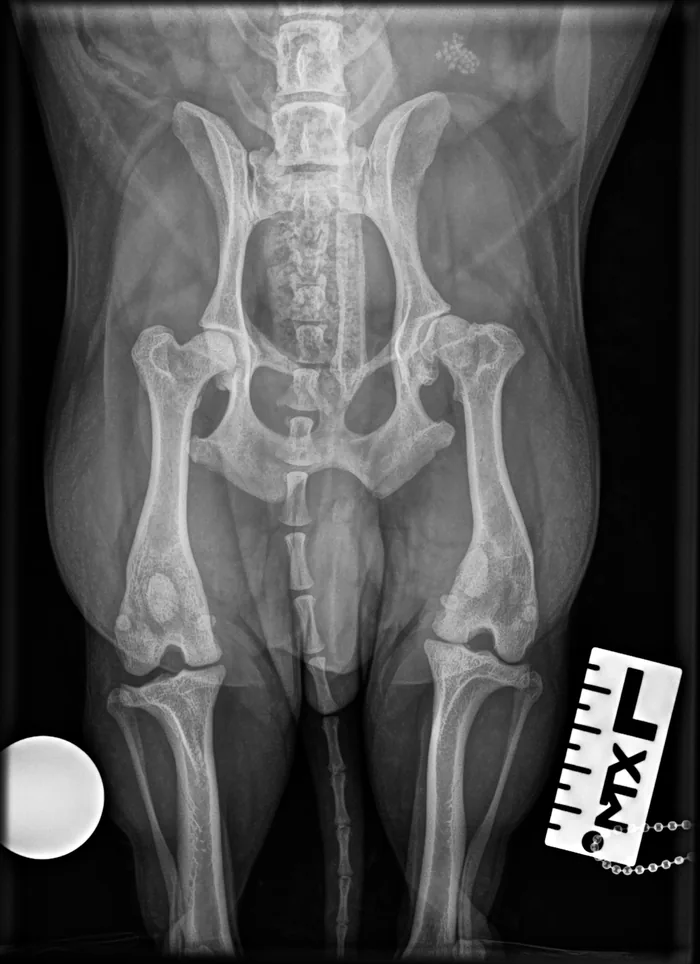
Why is my adult or older dog limping?
Common causes in adult dogs include paw injuries, sprains and strains after a slip or rough play, bite wounds, a slipping kneecap, fractures after an accident and, in a hind leg, cranial cruciate ligament disease — one of the most common causes of hind-leg lameness at this age. In older dogs, osteoarthritis becomes more common: an affected dog is slow to get up, stiff after rest and less keen to jump or play. A limp that does not go away should be X-rayed promptly — especially in a large- or giant-breed dog, or if there is a hard swelling on a leg bone — because a bone tumour is one possible cause. Not every limp starts in the leg: a slipped disc in the neck or back can press on the spinal cord or a nerve root and cause pain, lameness or weakness, particularly in breeds such as Dachshunds. If your dog suddenly cannot stand or walk, suddenly starts to drag its hind legs or knuckle over, or has sudden, severe back or neck pain, call a vet immediately, day or night. If it is wobbly but still walking, see a vet the same day.
What happens at a lameness examination?
The veterinarian first asks which leg is affected, how the limp started, whether it is worse after rest or exercise, and whether there was an accident — bring any videos you have. They then watch your dog stand, walk and trot, compare both sides for muscle loss and joint swelling, and feel every bone and flex every joint, usually leaving the sore leg until last. Specific tests check, for example, whether the shin bone slides forward relative to the thigh bone — a sign of a torn cruciate ligament. This cruciate ligament test is done under deep sedation so that the leg muscles relax. A neurological check helps tell a spine or nerve problem from a joint problem. Lameness X-rays are taken under general anaesthesia so that the joints can be positioned correctly without pain (read more about anaesthesia safety). We have digital X-ray at the clinic (X-ray). For CT or other advanced imaging, we refer your dog elsewhere.
What is a cruciate ligament rupture and how is it treated?
The cranial cruciate ligament stabilises the knee. In dogs it usually weakens gradually and often tears partially before it ruptures completely, and a partial tear almost always progresses to a full one. Typical signs are a hind-leg limp that starts suddenly or creeps up over weeks, stiffness after rest, and sitting with the leg stuck out to the side. An unstable knee can also damage the meniscus, the knee’s cartilage cushion, so do not wait. Surgery is usually recommended. At Saari Animal Clinic, veterinarian Pamela Kvarngård repairs cruciate ruptures using two methods. TTA suits active and large dogs. The lateral suture suits cats and small dogs, and often also medium-sized dogs and older, calmer large dogs. The choice depends on the individual dog. We check the menisci at every operation and treat any tear. We have performed knee surgery since 2017. Operations take place in a dedicated operating room used only for orthopaedic and other clean surgery. Recovery takes months of controlled, gradually increasing exercise. We always recommend physiotherapy after orthopaedic surgery: rehabilitation usually starts 1–2 weeks after the operation, and a visiting animal physiotherapist sees patients at our clinic.
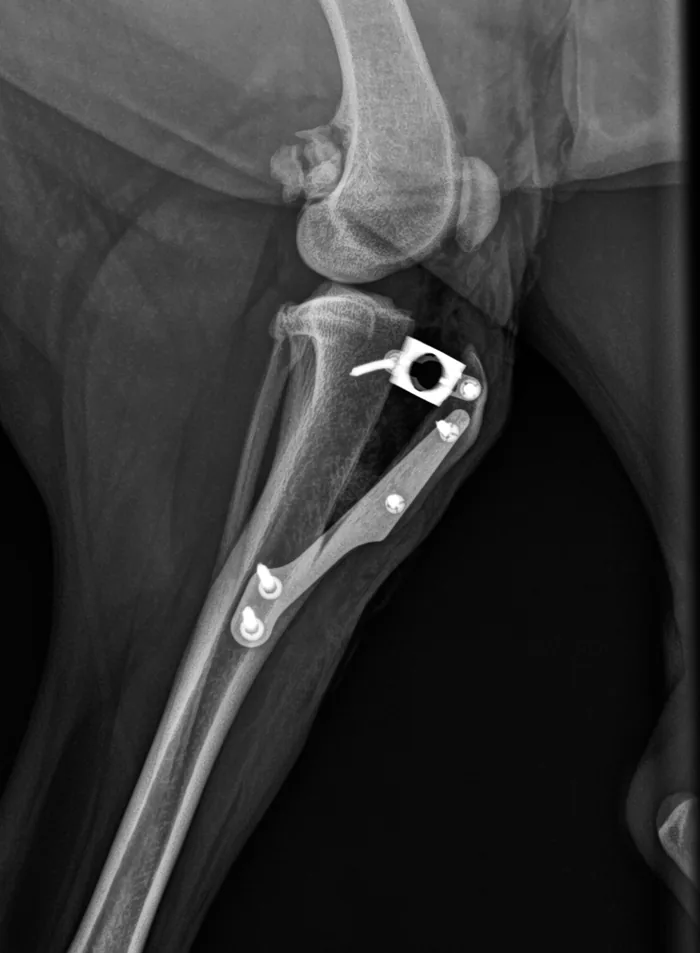
How can I help my dog with osteoarthritis?
Osteoarthritis cannot be cured, but its pain can be managed — and it is not only a disease of old dogs. In a 2024 study of 123 dogs aged 8 months to 4 years, 40% had osteoarthritis on X-rays, most often in the elbow or hip. Among the dogs whose arthritic joints were also painful, owners had noticed signs in only about 3 in 10. International guidelines recommend combining:
- Weight control — keeping your dog lean takes load off the joints, improves mobility and can slow the disease.
- Regular, moderate exercise — walks of a steady length every day rather than sudden bursts of high-impact play; non-slip rugs and ramps help at home.
- Pain medication prescribed by a veterinarian — anti-inflammatory medicine, or a monthly injection that blocks a key pain signal in osteoarthritis (nerve growth factor); your veterinarian decides which option suits your dog.
- Rehabilitation — at our clinic this includes functional assessment, manual therapy and massage, electrotherapy and individual exercise programmes (rehabilitation).
- Acupuncture — given by veterinarian Assaf Wydra, who has advanced training in acupuncture for dogs and horses (acupuncture).
A joint diet rich in omega-3 fatty acids can also help.
How much does a lameness examination cost?
At Saari Animal Clinic, a lameness examination costs €163. Deep sedation for the cruciate ligament test, if needed, is charged separately. A lameness examination with X-rays under general anaesthesia costs €273–323 (€323–453 for extensive examinations or large dogs). Prices for common orthopaedic operations:
- Cruciate ligament surgery, TTA€1,703 for dogs under 20 kg, €1,803 over 20 kg
- Cruciate ligament surgery, lateral suture€1,203 for dogs, €953 for cats
- Patellar luxation surgery€1,103–1,403 for dogs
- Femoral head ostectomy€1,203 for dogs
- Fracture surgery€1,203–2,003
- Toe amputation€593
The final cost depends on the findings and the treatment needed. Direct insurance billing is available for LähiTapiola, Agria and Pohjola customers. You will find all current prices in our price list.
How do I book a lameness examination in Vaasa?
Book an examination if your adult dog’s limp is not clearly better after 24–48 hours of strict rest, gets worse or keeps coming back, or if a puppy or young dog limps. Call a vet immediately, day or night, if your dog has been hit by a car or had a bad fall, if you suspect an adder bite, or if it suddenly cannot stand or walk. See a vet the same day if your dog will not put any weight on the leg or is wobbly but still walking. At Saari Animal Clinic in Vaasa, we investigate lameness, take X-rays on site, operate on cruciate ligaments, kneecaps and fractures, and offer rehabilitation and acupuncture. Book by calling (06) 321 7300 or using our online booking. After hours, if your dog needs urgent care, call the Northern emergency area’s on-call vet on 0600 399 299.
Sources
- Barnes K. (2026): Orthopedic Examination in Small Animals. Merck Veterinary Manual. merckvetmanual.com
- American College of Veterinary Surgeons (ACVS): Cranial Cruciate Ligament Disease. acvs.org
- Lafuente P. (2025): Elbow Dysplasia in Dogs. Merck Veterinary Manual. merckvetmanual.com
- Chou P.-Y. (2025): Developmental Osteopathies in Dogs and Cats (panosteitis). Merck Veterinary Manual. merckvetmanual.com
- Cachon T. ym. (2023): COAST Development Group’s international consensus guidelines for the treatment of canine osteoarthritis. Frontiers in Veterinary Science 10:1137888. pmc.ncbi.nlm.nih.gov
- Enomoto M. ym. (2024): Prevalence of radiographic appendicular osteoarthritis and associated clinical signs in young dogs. Scientific Reports 14:2827. pmc.ncbi.nlm.nih.gov
- Thomas W.B. (2021, updated 2025): Degenerative Diseases of the Spinal Column and Cord in Animals (intervertebral disk disease; cervical disk herniation with thoracic-limb lameness, nerve root signature). Merck Veterinary Manual. merckvetmanual.com
- Hovda T. (2024, updated 2025): Toxicoses From Human Analgesics in Animals. Merck Veterinary Manual. merckvetmanual.com