

Cranial cruciate ligament (CCL) rupture is one of the most common causes of hind-limb lameness in dogs; it is less common in cats. The lateral suture technique, also known as extracapsular lateral suture stabilization, is a well-established surgical method in which the knee is stabilized with synthetic material placed outside the joint. It is best suited to smaller and less active dogs, and it is also used in cats. At our clinic, the surgery is performed by veterinarian Pamela Kvarngård.
How Does Lateral Suture Work?
During surgery, the knee joint is opened and examined: remnants of the torn ligament are removed, and the menisci (the knee’s cartilage cushions) are checked and any torn portion removed. A strong monofilament nylon suture is then passed outside the joint, around the lateral fabella (a small bone behind the knee) and through a tunnel drilled in the top of the tibia (shinbone). It is locked in place with metal crimp clamps. This limits forward sliding of the tibia, much as a healthy cruciate ligament does. The suture is a temporary support: over the following weeks and months, scar tissue (periarticular fibrosis) forms around the joint and provides long-term stability.
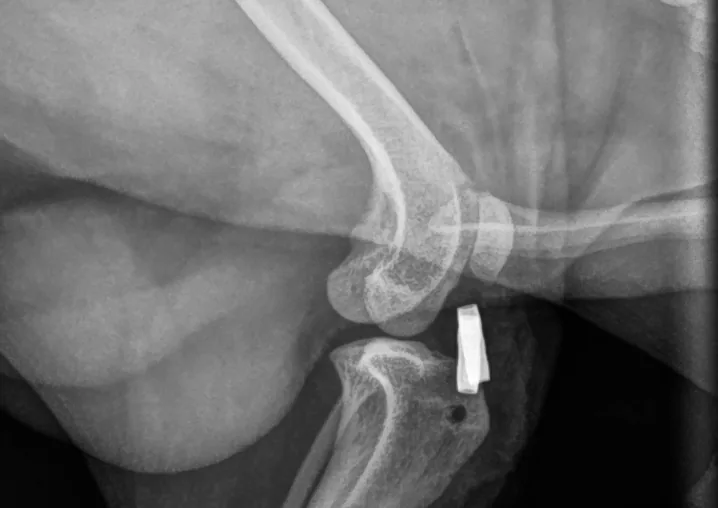
Who Is Lateral Suture Suitable For?
Lateral suture is a good choice for small dogs, many medium-sized dogs and older, calmer larger dogs. In published reports, around 85% of dogs regain complete or near-complete function after this surgery. In a large study, complications were more common in heavier and younger dogs. Some cats with an isolated cruciate rupture do well with rest and pain relief alone; when a cat needs surgery, lateral suture is a commonly used technique. For large, active dogs, we usually recommend TTA surgery instead.
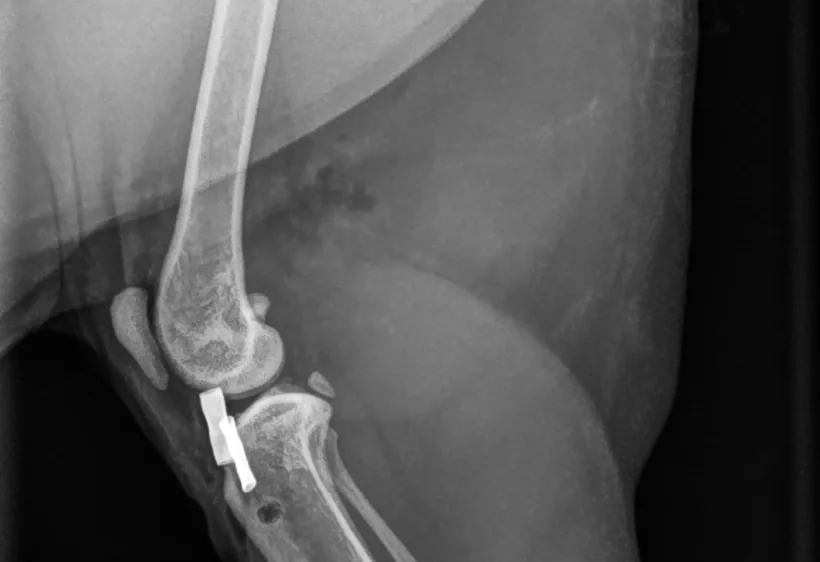
Recovery
The first 6–8 weeks after surgery are critical: activity is strictly limited so that scar tissue can form around the joint. Dogs go out only for short leash walks (5–15 minutes), with no jumping, running or stairs. The skin stitches are removed about 2 weeks after surgery. Walks are then gradually lengthened as your veterinarian advises, and most patients return to normal activity over about 3–4 months. Rehabilitation can improve limb function and support recovery. At our clinic it includes manual therapy and massage, electrotherapy and an individual exercise program, usually starting 1–2 weeks after surgery. Keeping your pet slim protects the knee in the long term.
Risks and Complications
In a study of 363 lateral suture surgeries in dogs, 17% had a complication and about 7% needed a second operation. The most common problems were wound issues such as swelling, discharge or licking; all of these settled without another operation. Infection (about 4%) was less common, but every infection was treated with another operation, usually including removal of the suture. A later meniscal tear can cause sudden lameness months after surgery; this occurred in about 2% of cases in that study and in up to 7% in other reports. The suture can also stretch, loosen or break before scar tissue has formed, bringing the lameness back. Following the recovery instructions carefully helps reduce these risks.
Our Orthopedic Operating Room
Because an infected implant usually means another operation, we perform orthopedic surgery in a separate operating room used only for orthopedic and other clean operations — never for dental work, abscesses, gut surgery or other contaminated procedures. During surgery, the doors stay closed and only the surgical team is in the room. A HEPA H13 air cleaner (about 15 air changes per hour at full power) clears the air in the room for 30 minutes before surgery and keeps running during the operation. The room is kept at positive pressure, so air flows out of it rather than in. Before surgery, the empty room is disinfected with ultraviolet (UV-C) light, and a far-UVC (222 nm) system, designed for use with people present, runs during the operation. These measures aim to reduce the risk of infection. We have performed cruciate ligament surgery since 2017.
Lateral Suture or TTA?
At our clinic we use two methods for cruciate ligament repair. Lateral suture stabilizes the joint with a synthetic suture without cutting bone; it is a shorter, more affordable procedure and a good option for smaller and less active patients. TTA permanently changes the forces in the knee by advancing the tibial tuberosity; many surgeons prefer bone-cutting techniques like this for larger, active dogs, although the evidence comparing the methods is limited. We always assess each pet individually to choose the method that suits them best.
When Should You Contact Us?
Suspect a cruciate ligament injury if your dog or cat limps on a hind leg, is reluctant to jump or climb stairs, is stiff after rest or has a leg that “gives way” during activity. Signs can start suddenly or develop over weeks. In dogs, a partial tear almost always progresses to a full rupture, and an unstable knee can damage the meniscus — so have the leg examined promptly. Arthritis tends to develop in the affected knee regardless of treatment, but it is expected to progress more slowly after surgery than with non-surgical care. About half of dogs later develop the same problem in the other knee, often within 12–18 months of diagnosis.
Price
Lateral suture surgery at our clinic costs 953 euros for cats and 1,203 euros for dogs. For comparison, TTA surgery costs 1,703 euros for dogs under 20 kg and 1,803 euros for dogs over 20 kg. The final cost may vary if additional examinations or treatment are needed; see our price list for current prices.
Sources
- Casale S.A. & McCarthy R.J. (2009): Complications associated with lateral fabellotibial suture surgery for cranial cruciate ligament injury in dogs: 363 cases (1997–2005). Journal of the American Veterinary Medical Association 234(2):229–235. doi.org/javma.234.2.229
- Marsolais G.S., Dvorak G. & Conzemius M.G. (2002): Effects of postoperative rehabilitation on limb function after cranial cruciate ligament repair in dogs. Journal of the American Veterinary Medical Association 220(9):1325–1330. doi.org/javma.2002.220.1325
- RCVS Knowledge, Canine Cruciate Registry: Extracapsular Lateral Suture Stabilisation (ELSS). rcvsknowledge.org
- American College of Veterinary Surgeons (ACVS): Cranial Cruciate Ligament Disease. acvs.org
- Boge G.S., Engdahl K., Moldal E.R. & Bergström A. (2020): Cranial cruciate ligament disease in cats: an epidemiological retrospective study of 50 cats (2011–2016). Journal of Feline Medicine and Surgery 22(4):277–284. pmc.ncbi.nlm.nih.gov/PMC10814672
- Montgomery P. (2025): In cats with cranial cruciate rupture are better long-term outcomes achieved by surgical or conservative management? Veterinary Evidence 10(2). doi.org/ve.v10i2.696
- Krotscheck U., Nelson S.A., Todhunter R.J., Stone M. & Zhang Z. (2016): Long term functional outcome of tibial tuberosity advancement vs. tibial plateau leveling osteotomy and extracapsular repair in a heterogeneous population of dogs. Veterinary Surgery 45(2):261–268. pubmed.ncbi.nlm.nih.gov
- Buonanno M., Welch D., Shuryak I. & Brenner D.J. (2020): Far-UVC light (222 nm) efficiently and safely inactivates airborne human coronaviruses. Scientific Reports 10:10285. pmc.ncbi.nlm.nih.gov/PMC7314750
- Spagnolo A.M., Ottria G., Amicizia D., Perdelli F. & Cristina M.L. (2013): Operating theatre quality and prevention of surgical site infections. Journal of Preventive Medicine and Hygiene 54(3):131–137. pmc.ncbi.nlm.nih.gov/PMC4718372