

Anesthesia is an essential part of surgery, dentistry, and many diagnostic procedures. Many owners worry about it, and that is understandable. For a healthy dog or cat, however, the risk is low. In the large UK CEPSAF study (Brodbelt et al. 2008; 98,036 anesthetics and sedations in dogs and 79,178 in cats, 2002–2004), about 1 in 600 dogs (0.17%) and 1 in 400 cats (0.24%) died of causes related to anesthesia or sedation within 48 hours. For healthy patients, the risk was much lower: 0.05% (1 in 1,849) in dogs and 0.11% (1 in 895) in cats. A newer study (Redondo et al. 2024) of 55,022 anesthetics in dogs at 405 clinics and hospitals in 21 countries (general practices, referral practices, and university hospitals) reported a figure of 0.69%. The two figures cannot be compared directly, because the patients and the definitions differed.
Risk Factors and ASA Classification
The patient’s health status is one of the most important risk factors. Before anesthesia, the patient’s condition is graded on the ASA scale (I–V). In healthy patients (ASA I–II) the risk is low; in sick patients (ASA III–V) it is many times higher: in the CEPSAF study, 1.33% in dogs and 1.40% in cats. Other risk factors include emergency or unscheduled procedures, more complex or major procedures, older age, very small body size (in cats, also very high body weight), and, in dogs, obesity. Brachycephalic (short-nosed) dogs have a higher risk of complications during and after anesthesia because of their narrow airways.
Modern Monitoring Saves Lives
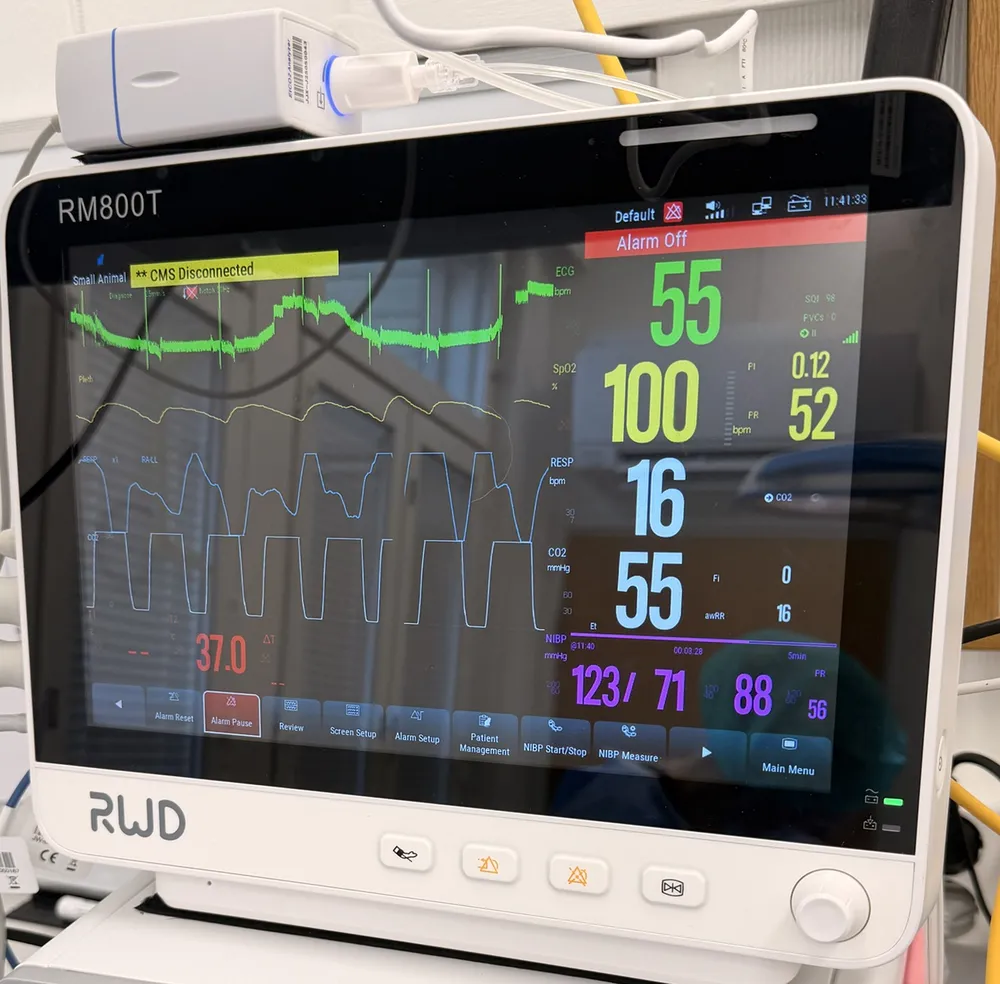
We closely monitor every patient under anesthesia. Our monitors track ECG (heart rhythm), pulse oximetry (oxygen saturation), capnography (exhaled carbon dioxide), non-invasive blood pressure, and body temperature. We also have two ventilators to support breathing, and we listen to the heart before and during the procedure. Most importantly, a trained person interprets the monitors and responds to changes; devices do not replace a vigilant professional. Monitoring continues into recovery: in the CEPSAF study, 47% of anesthetic- and sedation-related deaths in dogs and 61% in cats occurred after the procedure, many of them within the first three hours after anesthesia ended.
Balanced Anesthesia and Pain Management
Modern anesthesia uses a multimodal (“balanced”) approach: combining several drugs at lower doses gives a safer overall result than one drug at a high dose. We use intravenous anesthetics (propofol or alfaxalone) for induction, the inhalant anesthetic isoflurane for maintenance, and opioids, ketamine, and local anesthetics for pain management. This balanced protocol lowers the dose of each drug and, with it, the side effects, especially depression of the heart and circulation.
A Finnish Veterinary Innovation — Vatinoxan
In a 2024 interview in the University of Helsinki’s Yliopisto magazine, veterinary anesthesiologist Vilhelmiina Huuskonen, at the time an associate professor at University College Dublin, noted that death under anesthesia is more common in animals than in humans. Her doctoral thesis at the University of Helsinki (November 2024) studied vatinoxan given together with the sedatives medetomidine and dexmedetomidine in dogs and sheep. Vatinoxan acts mainly outside the brain, so it counteracts these sedatives’ unwanted cardiovascular effects (slow heart rate, constricted blood vessels with raised blood pressure, and reduced cardiac output). Sedation and pain relief are largely preserved, although they wear off somewhat sooner. In her research, blood pressure could fall when dogs given dexmedetomidine and vatinoxan were then kept under isoflurane anesthesia. Her thesis showed that such a drop can be treated effectively with standard medicines that raise blood pressure, and that it must be monitored closely. The molecule had earlier been studied in humans for diabetes; the combination with animal sedatives was designed by a research group led by Outi Vainio (now Professor Emerita) at the University of Helsinki. The resulting product for dogs, Zenalpha (medetomidine + vatinoxan), was developed in cooperation with the Finnish company Vetcare. It was authorized in the EU in December 2021 and in the US in March 2022 for sedation during examinations and minor procedures.
Before Anesthesia
Every patient is assessed individually before anesthesia. The pre-anesthetic evaluation includes a clinical examination and auscultation of the heart and lungs. Blood tests (complete blood count and biochemistry) are recommended when the patient’s age, history, or examination calls for them, for example in older or sick animals; the 2020 AAHA guidelines likewise tailor pre-anesthetic diagnostics to the individual patient. Blood tests can reveal hidden kidney or liver disease, anemia, or electrolyte imbalances that affect drug selection and dosing. If the findings are significant, the procedure may be postponed so the patient can be stabilized first.
Sources
- Brodbelt D.C. ym. (2008): The risk of death: the Confidential Enquiry into Perioperative Small Animal Fatalities. Veterinary Anaesthesia and Analgesia 35(5):365–373. pubmed.ncbi.nlm.nih.gov/18466167
- Brodbelt D.C. ym. (2007): Risk factors for anaesthetic-related death in cats: results from the confidential enquiry into perioperative small animal fatalities (CEPSAF). British Journal of Anaesthesia 99(5):617–623. pubmed.ncbi.nlm.nih.gov/17881744
- Brodbelt D.C. ym. (2008): Results of the confidential enquiry into perioperative small animal fatalities regarding risk factors for anesthetic-related death in dogs. JAVMA 233(7):1096–1104. pubmed.ncbi.nlm.nih.gov/18828720
- Redondo J.I. ym. (2024): Anaesthetic mortality in dogs: A worldwide analysis and risk assessment. Veterinary Record 195(1):e3604. pubmed.ncbi.nlm.nih.gov/37953683
- Grubb T. ym. (2020): 2020 AAHA Anesthesia and Monitoring Guidelines for Dogs and Cats. Journal of the American Animal Hospital Association 56(2):59–82. pubmed.ncbi.nlm.nih.gov/32078360
- Gruenheid M. ym. (2018): Risk of anesthesia-related complications in brachycephalic dogs. JAVMA 253(3):301–306. pubmed.ncbi.nlm.nih.gov/30020004
- Huuskonen V. (2024): Clinical justification for co-administering vatinoxan with (dex)medetomidine in dogs and sheep. Väitöskirja, Helsingin yliopisto. hdl.handle.net
- Mattila R. (2024): Nukutus on eläimelle isompi riski kuin ihmiselle. Yliopisto-lehti 9/2024, Helsingin yliopisto. helsinki.fi/nukutus-elaimelle-isompi-riski-kuin-ihmi
- Helsingin yliopisto (2022): Increasingly safe canine sedation – A new veterinary drug discovery goes global. helsinki.fi/increasingly-safe-canine-sedation-new-ve
- Union Product Database: Zenalpha 0,5 mg/ml + 10 mg/ml injektioneste, liuos, koirille. medicines.health.europa.eu
- U.S. FDA: Freedom of Information Summary, NADA 141-551 Zenalpha. animaldrugsatfda.fda.gov