

Hypothermia is one of the most common complications of anesthesia. In two Spanish studies, body temperature at the end of anesthesia was below 38.5 °C (the studies’ lower limit of normal) in 84% of dogs and 97% of cats, and below 36.5 °C in 32% of dogs and 71% of cats. Anesthetic agents impair the body’s temperature regulation, blood vessels dilate, and small patients lose heat rapidly. Hypothermia slows drug metabolism, prolongs recovery, and can impair blood clotting and heart function; in people, it also increases the risk of wound infection.
Consequences of Hypothermia
Cooling slows how quickly the body clears anesthetic drugs, and in dogs, a lower body temperature has been linked to slower recovery. A cold body also needs less anesthetic — at 34.5 °C, dogs require about a quarter less of the anesthetic gas isoflurane — so the usual dose can make anesthesia too deep. Cold impairs blood clotting: in human surgery, even a temperature drop of less than 1 °C increased blood loss by about 16%. In people, a core temperature about 2 °C lower tripled the rate of wound infection after bowel surgery (19% vs. 6%); in dogs and cats, results are mixed. Deep cooling — in people, below about 30–32 °C — can lead to cardiac arrest.
Active Warming — Forced-Air Warmers
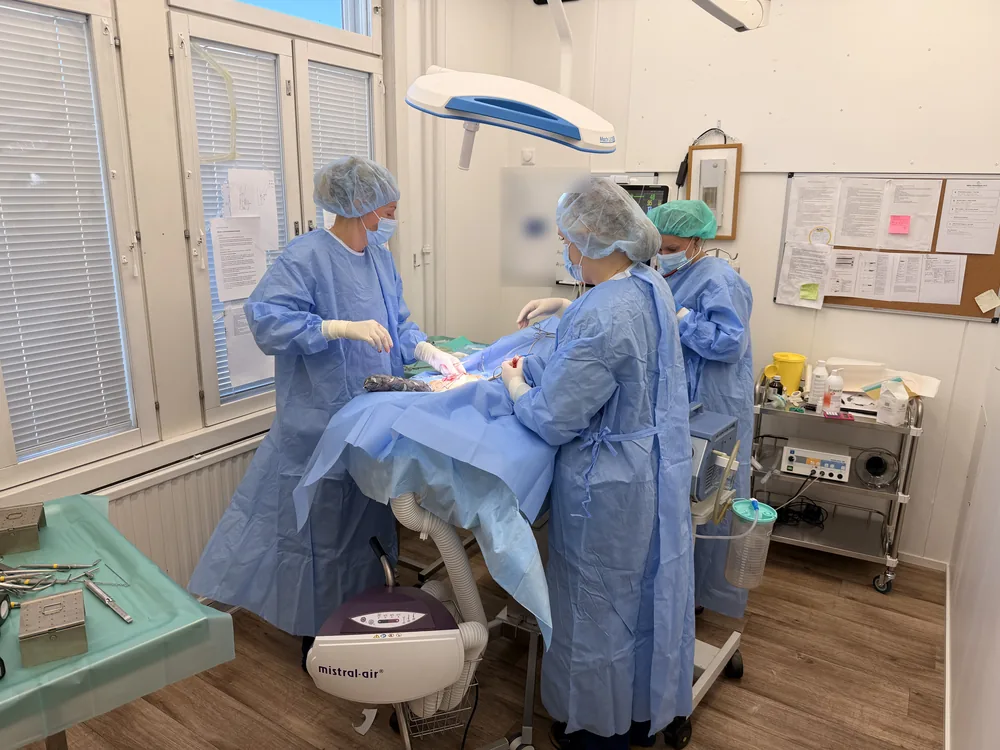
Our clinic has three forced-air warmers, which blow warm air around the patient through a single-use blanket. Guidelines from the American Animal Hospital Association (AAHA) name warm-air systems and circulating warm-water blankets as the most effective heating methods. In a study of eight dogs, a forced-air blanket over the dog limited heat loss better than a towel or a warm-water pad underneath. In small studies, warmed IV fluids alone did not prevent hypothermia in cats or dogs, and insulation (blankets, socks) slows cooling but does not stop it. That is why we combine forced-air warming with warmed fluids and insulation.
Monitoring During Recovery
Anesthesia-related deaths are rare: in large studies from the UK and around the world, they affected fewer than 1% of patients. Yet 47–81% of these deaths in dogs and 61–75% in cats occurred after the procedure — in the UK study, most often within the first three hours. AAHA recommends monitoring recovering patients as closely as during anesthesia and warming them throughout recovery. We continue warming the patient and monitor its temperature, oxygen saturation, and blood pressure until it is fully awake and its body temperature is back to normal.
Safe Warming
Electric heating pads and hot-water bottles designed for people are dangerous for anesthetized animals — they cannot move away from an overheated surface or express pain. Burns have been documented: four anesthetized dogs were burned by surgical gloves filled with warm water. AAHA warns: “Do not use supplemental heat sources that are not designed specifically for anesthetized patients as they can cause severe thermal injury.” Forced-air warmers and other devices designed for anesthetized patients are the right choice when used as instructed.
Sources
- Clark-Price S. (2015): Inadvertent Perianesthetic Hypothermia in Small Animal Patients. Veterinary Clinics of North America: Small Animal Practice 45(5):983–994. pubmed.ncbi.nlm.nih.gov
- Redondo J.I. ym. (2012): Retrospective study of the prevalence of postanaesthetic hypothermia in dogs. Veterinary Record 171(15):374. pubmed.ncbi.nlm.nih.gov
- Redondo J.I. ym. (2012): Retrospective study of the prevalence of postanaesthetic hypothermia in cats. Veterinary Record 170(8):206. pubmed.ncbi.nlm.nih.gov
- Pottie R.G. ym. (2007): Effect of hypothermia on recovery from general anaesthesia in the dog. Australian Veterinary Journal 85(4):158–162. pubmed.ncbi.nlm.nih.gov
- Wilson D. ym. (2006): Effect of transdermally administered fentanyl on minimum alveolar concentration of isoflurane in normothermic and hypothermic dogs. Journal of the American Veterinary Medical Association 228(7):1042–1046. pubmed.ncbi.nlm.nih.gov
- Rajagopalan S. ym. (2008): The effects of mild perioperative hypothermia on blood loss and transfusion requirement. Anesthesiology 108(1):71–77. pubmed.ncbi.nlm.nih.gov
- Kurz A. ym. (1996): Perioperative normothermia to reduce the incidence of surgical-wound infection and shorten hospitalization. New England Journal of Medicine 334(19):1209–1215. pubmed.ncbi.nlm.nih.gov
- Beal M.W. ym. (2000): The effects of perioperative hypothermia and the duration of anesthesia on postoperative wound infection rate in clean wounds: a retrospective study. Veterinary Surgery 29(2):123–127. pubmed.ncbi.nlm.nih.gov
- Fuertes-Recuero M. ym. (2025): Incidence and Risk Factors of Surgical Site Infection in 376 Mastectomy Procedures in Female Dogs: A Retrospective Cohort Study. Veterinary Sciences 12(6):553. pubmed.ncbi.nlm.nih.gov
- Paal P. ym. (2022): Accidental Hypothermia: 2021 Update. International Journal of Environmental Research and Public Health 19(1):501. pubmed.ncbi.nlm.nih.gov
- Grubb T. ym. (2020): 2020 AAHA Anesthesia and Monitoring Guidelines for Dogs and Cats. Journal of the American Animal Hospital Association 56(2):59–82. pubmed.ncbi.nlm.nih.gov
- Clark-Price S.C. ym. (2013): Comparison of three different methods to prevent heat loss in healthy dogs undergoing 90 minutes of general anesthesia. Veterinary Anaesthesia and Analgesia 40(3):280–284. pubmed.ncbi.nlm.nih.gov
- Jourdan G. ym. (2017): Heated intravenous fluids alone fail to prevent hypothermia in cats under general anaesthesia. Journal of Feline Medicine and Surgery 19(12):1249–1253. pubmed.ncbi.nlm.nih.gov
- Atayde I.B. ym. (2009): Fluid Heating System (SAF): effects on clinical and biochemistry parameters in dogs submitted to inhalatory anesthesia. Acta Cirúrgica Brasileira 24(2):144–149. pubmed.ncbi.nlm.nih.gov
- Kreisler R.E. ym. (2025): Insulating the extremities of cats with highly insulating materials during anesthesia reduces core temperature decline with additional benefit from active warming. Journal of the American Veterinary Medical Association 263(9):1106–1113. pubmed.ncbi.nlm.nih.gov
- Brodbelt D.C. ym. (2008): The risk of death: the confidential enquiry into perioperative small animal fatalities. Veterinary Anaesthesia and Analgesia 35(5):365–373. pubmed.ncbi.nlm.nih.gov
- Redondo J.I. ym. (2024): Anaesthetic mortality in dogs: A worldwide analysis and risk assessment. Veterinary Record 195(1):e3604. pubmed.ncbi.nlm.nih.gov
- Redondo J.I. ym. (2024): Anaesthetic mortality in cats: A worldwide analysis and risk assessment. Veterinary Record 195(1):e4147. pubmed.ncbi.nlm.nih.gov
- Dunlop C.I. ym. (1989): Thermal burns in four dogs during anesthesia. Veterinary Surgery 18(3):242–246. pubmed.ncbi.nlm.nih.gov