

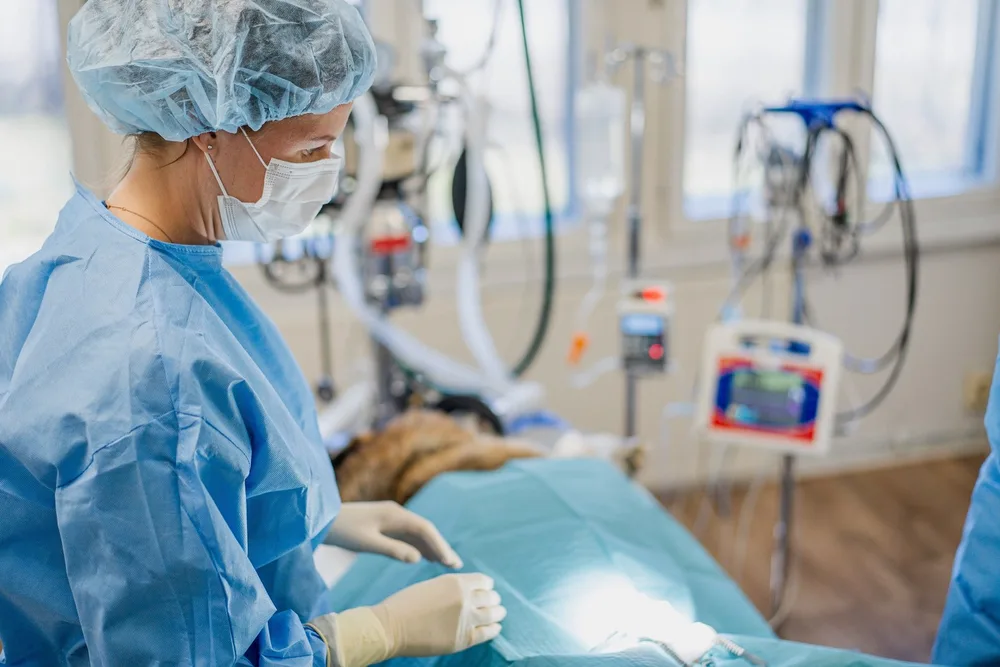
Pain management is one of the most important parts of any surgery. At our clinic, a pain-relief infusion is a routine part of larger operations, such as dog spays and orthopedic surgery. It is known as a constant rate infusion (CRI), also called a continuous rate infusion. Rather than relying only on separate injections, a CRI delivers pain medication into a vein at a steady, precisely controlled rate, usually after a starting dose. We start the infusion before the first incision and continue it throughout the operation.
Why Continuous Infusion?
When a pain medication is given as separate injections, its level in the blood rises after each dose and then falls. If it falls too low before the next dose, pain can break through, while high peaks can increase side effects. A continuous infusion keeps the level steadier, giving more even pain relief. The rate can also be adjusted as needed. In some studies of dogs undergoing major surgery, adding a ketamine infusion, alone or with lidocaine, reduced pain or the need for extra pain medication afterward.
The Multimodal Approach
Each type of pain medication acts mainly at certain points along the pain pathway. Combining drugs that act at different points (multimodal pain relief) gives better pain control. Because each drug can then be used at a lower dose, the risk of side effects is also reduced. A pain-relief CRI is typically built around an opioid (a morphine-type pain medication), often combined with ketamine, lidocaine or dexmedetomidine. It is usually given alongside other pain relief, such as anti-inflammatory drugs or numbing local anesthetic blocks. The drugs are chosen to suit each patient and species.
Less Anesthetic Gas Needed
Pain-relief infusions can also reduce the amount of anesthetic gas needed. In a laboratory study, six dogs were anesthetized with isoflurane — the gas we use. Low-dose infusions of morphine, lidocaine and ketamine, alone or combined, reduced the amount of isoflurane needed by about 25–50% without lowering blood pressure. Pain guidelines note that this effect of lidocaine may help dogs with low blood pressure who would otherwise need a lot of gas. In a similar study in cats, lidocaine also reduced the amount of gas needed, but the cats’ hearts pumped less blood than under equally deep anesthesia with gas alone. Lidocaine infusions are therefore used in cats only with caution.
Use at Our Clinic
We routinely use a multimodal pain-relief CRI in dog spays, tumor and mammary surgery, abdominal surgery and orthopedic surgery, such as cruciate ligament and fracture repair. When needed, the infusion continues after surgery. Castrations and cat spays are painful too, but for these operations we provide pain relief in other ways.
What Is Pain “Wind-Up”?
When pain signals keep arriving, nerve cells in the spinal cord can respond more and more strongly — this is called wind-up. A related, longer-lasting change is central sensitization: the nervous system amplifies pain so that even light touch can hurt. Because pain that has already set in is harder to treat, pain guidelines recommend giving pain relief before, during and after surgery. Ketamine, often part of a CRI, blocks NMDA receptors — nerve-cell receptors that play a key role in this amplification. However, more research is needed on its use around surgery. Good pain control reduces the risk of sensitization but cannot rule it out.
Safety
Using several drugs at lower doses helps reduce side effects, but any drug can still cause them. CRI drugs can, for example, lower blood pressure or heart rate, or cause a restless recovery. Every patient is monitored throughout anesthesia, and the anesthetist adjusts the infusion rate according to what the monitoring shows. Feel free to ask us how your pet’s pain will be managed.
Sources
- Monteiro B.P. ym. (2023): 2022 WSAVA guidelines for the recognition, assessment and treatment of pain. Journal of Small Animal Practice 64(4):177–254. doi.org
- Steagall P.V. ym. (2022): 2022 ISFM Consensus Guidelines on the Management of Acute Pain in Cats. Journal of Feline Medicine and Surgery 24(1):4–30. pmc.ncbi.nlm.nih.gov/PMC10845386
- Gruen M.E. ym. (2022): 2022 AAHA Pain Management Guidelines for Dogs and Cats. Journal of the American Animal Hospital Association 58(2):55–76. pubmed.ncbi.nlm.nih.gov/35195712
- Guedes A. (2012): Pain Management: Constant-Rate Infusion. Clinician’s Brief, March 2012. cliniciansbrief.com
- Muir W.W. ym. (2003): Effects of morphine, lidocaine, ketamine, and morphine-lidocaine-ketamine drug combination on minimum alveolar concentration in dogs anesthetized with isoflurane. American Journal of Veterinary Research 64(9):1155–1160. pubmed.ncbi.nlm.nih.gov/13677395
- Pypendop B.H., Ilkiw J.E. (2005): Assessment of the hemodynamic effects of lidocaine administered IV in isoflurane-anesthetized cats. American Journal of Veterinary Research 66(4):661–668. pubmed.ncbi.nlm.nih.gov/15900948
- Wagner A.E. ym. (2002): Use of low doses of ketamine administered by constant rate infusion as an adjunct for postoperative analgesia in dogs. Journal of the American Veterinary Medical Association 221(1):72–75. pubmed.ncbi.nlm.nih.gov/12420827
- Marques É.J. ym. (2023): Influence of constant rate infusions of fentanyl alone or in combination with lidocaine and ketamine on the response to surgery and postoperative pain in isoflurane anesthetized dogs undergoing unilateral mastectomy: a randomized clinical trial. Topics in Companion Animal Medicine 52:100759. pubmed.ncbi.nlm.nih.gov/36587868
- Becker W.M. ym. (2013): Prevalence of dysphoria after fentanyl in dogs undergoing stifle surgery. Veterinary Surgery 42(3):302–307. pubmed.ncbi.nlm.nih.gov/23231071
- Woolf C.J. (2011): Central sensitization: implications for the diagnosis and treatment of pain. Pain 152(3 Suppl):S2–S15. pmc.ncbi.nlm.nih.gov/PMC3268359
- Kronen P.W. ym. (2026): N-methyl-D-aspartate receptor antagonists for controlling pain in dogs. Journal of Small Animal Practice, online ahead of print (doi:10.1111/jsap.70205). pubmed.ncbi.nlm.nih.gov/42767761
- WSAVA Pain Committee (2024): Soft Tissue Surgery — pain management protocol. wsava.org/Soft-tissue-Surgery.pdf
- WSAVA Pain Committee (2024): Castration and Ovariohysterectomy/Ovariectomy: Dogs — pain management protocol. wsava.org/Castration-and-OVH-Dogs.pdf
- WSAVA Pain Committee (2024): Castration and Ovariohysterectomy/Ovariectomy: Cats — pain management protocol. wsava.org/Castration-and-OVH-cats.pdf