

A veterinarian who is operating cannot give the anaesthetic their full attention. A trained veterinary nurse watches the monitors, responds to changes and cares for the patient before, during and after surgery. In large studies, the main risk factors for anaesthetic death are the patient’s health before anaesthesia (ASA classification), age, body weight, and how major and how urgent the procedure is. These can rarely be changed on the day, but monitoring can: in cats, checking the pulse and using a pulse oximeter during anaesthesia have been linked to a lower risk of death. At our clinic, a trained nurse monitors the anaesthetic, so the veterinarian can concentrate on the operation.
The Nurse’s Role at the Clinic
The veterinary nurse prepares the patient for surgery: placing an IV catheter, giving the premedication prescribed by the veterinarian and preparing the surgical site. During surgery, the nurse monitors the anaesthesia — tracking heart rhythm, oxygen saturation, exhaled carbon dioxide (capnography) and temperature — and reports changes to the veterinarian. As a sterile assistant, the nurse passes instruments, maintains the sterile field and spots possible contamination. After the procedure, the nurse monitors recovery, which is a critical phase: in large studies, roughly half to four-fifths of anaesthetic deaths happened after the procedure rather than during it.
What Research Shows
The UK CEPSAF study (Brodbelt et al.) covered 185,423 anaesthetics and sedations in dogs, cats and rabbits at 117 practices. It found that cats whose pulse was checked or who were monitored with a pulse oximeter during anaesthesia were three to five times less likely to die; no such link was found in dogs. The study also recorded who monitored the anaesthetic — a veterinarian, a qualified nurse or an unqualified nurse — but in the final statistical analysis this was not among the factors linked to death. Timing matters too: in the same study, 47% of anaesthetic-related deaths in dogs and 61% in cats happened after the procedure. Of these, nearly half in dogs and about three in five in cats occurred within three hours of the end of the procedure. Two worldwide studies (Redondo et al. 2024) found that 81% of anaesthetic deaths in dogs and 74.5% in cats happened after the procedure. In the US Banfield Pet Hospital network, a package of anaesthesia standards was followed by a 16% fall in deaths occurring within a week of anaesthesia, from 7.4 to 6.2 per 10,000 anaesthetics (November 2017 to January 2020). The standards included having at least one trained staff member whose sole task is continuous monitoring and recovery during every sedation and general anaesthetic. Because they were introduced together, the effect of any single standard cannot be isolated.
Education in Finland
Finnish veterinary nurses train in the vocational education system, which has three levels. At the basic level, the animal attendant qualification (eläintenhoitaja) covers general animal care and is today part of the vocational qualification in agriculture. The further vocational qualification in animal care, clinic track (klinikkaeläinhoitaja), is the veterinary nurse training proper: assisting in the operating theatre, monitoring anaesthesia and recovery, giving medicines as instructed by the veterinarian, radiography, laboratory work and customer service. The highest level is the specialist vocational qualification (erikoisammattitutkinto, EAT). Its compulsory module covers organising clinic work and mentoring colleagues and students; nurses then choose in-depth modules such as anaesthesia, acute and intensive care, diagnostic imaging, surgical or internal medicine nursing, or dentistry. Skills are demonstrated on the job at a veterinary clinic.
Jenni Ruotsala — Our Head Veterinary Nurse
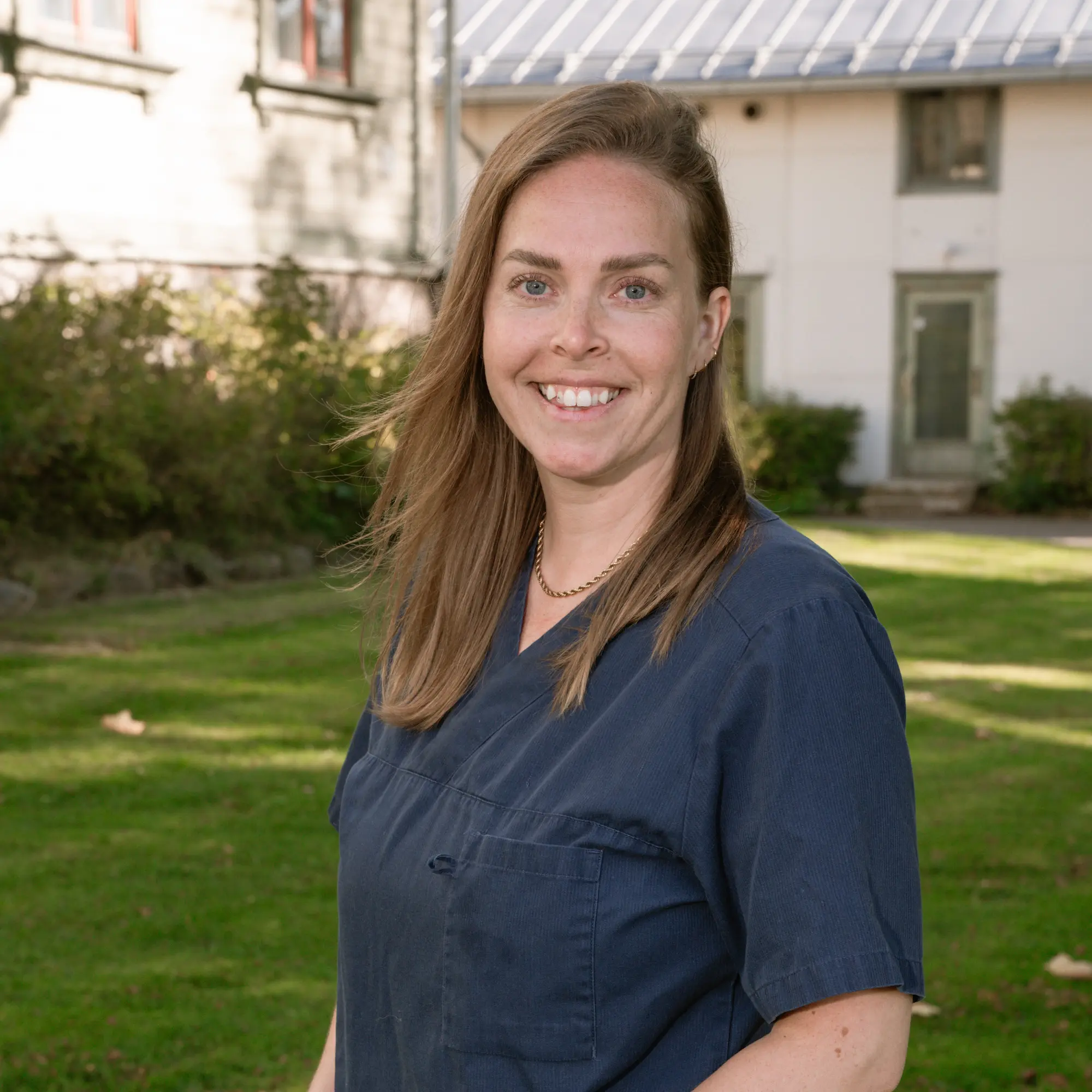
Our head veterinary nurse, Jenni Ruotsala, has worked at the clinic since 2014. She qualified as an animal attendant (eläintenhoitaja) in 2010 and as a veterinary nurse (klinikkaeläinhoitaja) in 2018. In 2024–2025 she deepened her skills in anaesthesia and now holds the specialist vocational qualification (EAT) — the highest level of vocational qualification in Finland. Jenni has also completed further training in dentistry at Accesia Academy in Sweden.
Sources
- Brodbelt D.C. ym. (2008): The risk of death: the Confidential Enquiry into Perioperative Small Animal Fatalities. Veterinary Anaesthesia and Analgesia 35(5):365–373. doi.org/j.1467-2995.2008.00397.x
- Brodbelt D.C. ym. (2008): Results of the confidential enquiry into perioperative small animal fatalities regarding risk factors for anesthetic-related death in dogs. Journal of the American Veterinary Medical Association 233(7):1096–1104. doi.org/javma.233.7.1096
- Brodbelt D.C. ym. (2007): Risk factors for anaesthetic-related death in cats: results from the confidential enquiry into perioperative small animal fatalities (CEPSAF). British Journal of Anaesthesia 99(5):617–623. doi.org/aem229
- Redondo J.I. ym. (2024): Anaesthetic mortality in dogs: a worldwide analysis and risk assessment. Veterinary Record 195(1):e3604. pubmed.ncbi.nlm.nih.gov/37953683
- Redondo J.I. ym. (2024): Anaesthetic mortality in cats: a worldwide analysis and risk assessment. Veterinary Record 195(1):e4147. pubmed.ncbi.nlm.nih.gov/38959210
- Morrison J.A. ym. (2022): Development and implementation of veterinary anesthesia medical quality standards for primary care. Veterinary Anaesthesia and Analgesia 49(3):233–242. doi.org/j.vaa.2022.01.009
- Finnish National Agency for Education (2025): Vocational Qualification in Agriculture — qualification requirements, OPH-7411-2025 (in force from 1.8.2026). ePerusteet. eperusteet.opintopolku.fi
- Finnish National Agency for Education (2025): Further vocational qualification in Animal Care — qualification requirements, OPH-2142-2025 (in force from 1.8.2025). ePerusteet. eperusteet.opintopolku.fi (2)
- Finnish National Agency for Education (2025): Specialist vocational qualification in Animal Care — qualification requirements, OPH-2143-2025 (in force from 1.8.2025). ePerusteet. eperusteet.opintopolku.fi (3)