

Pyometra is a life-threatening infection in which the uterus of an unspayed female fills with pus. It is one of the most common serious diseases of intact bitches: roughly one in five unspayed female dogs (19–24% in Swedish insurance data) develops it by the age of 10. It also occurs in cats. The condition usually needs emergency surgery, and recognising the signs early can save your pet’s life. This article explains what the symptoms look like, how quickly pyometra develops, why antibiotics alone are not enough, how it is treated at Saari Animal Clinic, what recovery involves and how to prevent it.
What are the symptoms of pyometra in dogs?
The clearest sign is a pus-like discharge from the vulva — yellowish, brownish or the colour of old blood, often foul-smelling — and the dog licking her rear end more than usual. This is called an “open” pyometra. In a “closed” pyometra the cervix is shut and nothing drains out, so there is no telltale discharge — yet the dog is often more seriously ill. Signs seen in both forms include drinking and urinating much more, refusing food, tiredness and apathy, vomiting, a swollen or painful belly, and fever or, in severe cases, a below-normal temperature. If an unspayed bitch is listless, off her food or drinking a lot in the weeks or months after her heat, see a vet the same day.
How does pyometra start and how fast does it progress?
Bacteria — usually E. coli from the dog’s own gut — can enter the uterus through the cervix, which is open during a heat. In the weeks that follow, progesterone thickens the uterine lining and weakens its defences, and the infection takes hold. This is why pyometra is usually diagnosed within four months of a heat. An open pyometra may smoulder for days to weeks with discharge as the main sign. A closed pyometra can make a dog seriously ill within days, because toxins and bacteria pass from the uterus into the bloodstream. Neither form is safe to wait out, even if the dog seems only mildly unwell. By the time they reach the vet, around 60% of dogs with pyometra already have sepsis, a life-threatening whole-body reaction to the infection. In one Swedish study, sepsis was present in three in four dogs with a closed cervix and one in two with an open one. Any suspicion of pyometra is therefore an emergency: the sooner surgery is done, the better the outcome.
What causes pyometra and which dogs get it?
The underlying cause is hormonal: after every heat, progesterone prepares the uterus for pregnancy, and over the years these repeated cycles can cause cystic thickening of the lining, which makes infection more likely. Pyometra is therefore a disease of intact (unspayed) females, most often middle-aged and older. The typical age at diagnosis is about 7 years in Swedish data and 9 in Finnish data, but pyometra can occur after the first heat. Having had puppies lowers the risk somewhat but does not rule it out. Oestrogen injections given to prevent pregnancy after an unwanted mating are a well-documented risk factor. Breed matters a great deal: in Swedish insurance data, more than half of intact Bernese Mountain Dog, Great Dane, Leonberger, Rottweiler and Irish Wolfhound bitches developed pyometra by the age of 10. In Finnish Spitz bitches, by contrast, the figure was only about 3%. Dachshunds and, in Finnish data, mixed-breed dogs have shown a lower-than-average risk.
Can pyometra heal on its own or with antibiotics?
No. Untreated pyometra is life-threatening: the uterus can rupture, and the infection can lead to sepsis, kidney damage and peritonitis. Antibiotics alone may slow the disease down, but they do not heal the uterus. Medical treatment with hormonal drugs plus antibiotics is an option only for selected patients: young, otherwise healthy breeding bitches with an open pyometra and no signs of sepsis. Even then, pyometra comes back at a later heat in about three in ten dogs on average (29%; the reported range across studies is 0–85%). The bitch should therefore be bred at her very next heat. Only surgery reliably prevents a recurrence. For all other patients, surgery is the treatment of choice. We do not offer hormonal treatment at Saari; we recommend surgery in nearly every case.
How is pyometra diagnosed?
We examine the dog, run blood tests (white blood cell count, kidney and liver values) and do an ultrasound scan of her abdomen. About six in ten dogs with pyometra have a raised white cell count, more often with a closed pyometra; a low count is a warning sign of peritonitis. The ultrasound scan shows within minutes whether the uterus is enlarged and filled with fluid; together with the other findings, this is usually enough to make the diagnosis. Because a closed pyometra can look like many other illnesses, we scan any unspayed bitch who is unwell in the weeks or months after a heat, even if there is no discharge.
How is pyometra treated?
The treatment is emergency surgery to remove the infected uterus and the ovaries (ovariohysterectomy). The operation is similar to a spay, but it is done on a sick patient with an enlarged, fragile uterus, so it is carried out with extra care. Before surgery, the dog is stabilised with intravenous fluids and, if she is more seriously ill, antibiotics. While she is under inhalation anaesthesia, her vital functions are monitored continuously. The prognosis with surgery is good: over 90% of dogs recover. Once the uterus and both ovaries have been removed, the disease practically never returns. The rare exception, “stump pyometra”, develops in the small stump of uterus left at the cervix, most often because some ovarian tissue was left behind at surgery. Delaying surgery gives sepsis, peritonitis and uterine rupture time to develop — the complications that make pyometra so dangerous.
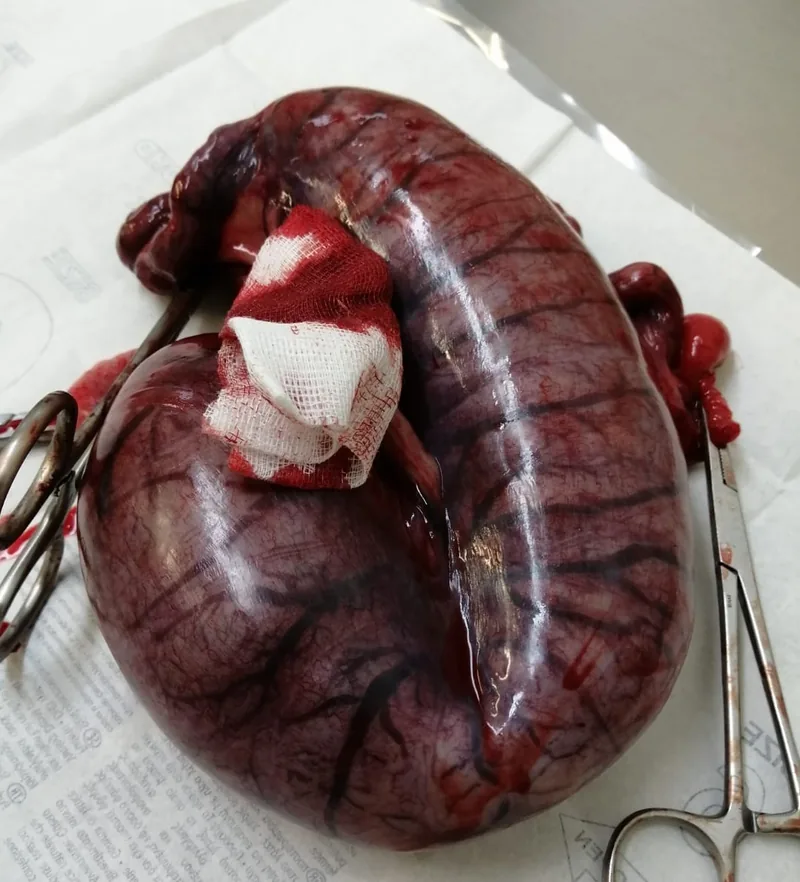
How much does pyometra surgery cost?
Pyometra surgery is priced case by case, because the operation, the fluids and antibiotics, the anaesthesia time and any hospitalisation depend on the size of the dog and on how ill she is when she arrives. You will receive a cost estimate before surgery. For comparison, a planned spay of a healthy bitch costs 483–753 € depending on her weight. An emergency pyometra operation costs more than that — and the earlier the dog is brought in, the less intensive care she needs. Direct insurance billing is available for LähiTapiola, Agria and Pohjola customers.
How long is recovery after pyometra surgery?
Most dogs are noticeably brighter within a day or two of surgery, once the source of the infection is gone. They go home with pain relief and, when the vet judges it necessary, a short course of antibiotics. For 10–14 days, until the wound has healed and any skin stitches have been removed, the dog wears a recovery suit or cone and is kept to short walks on the lead. We re-check the wound and her general condition after surgery and repeat blood tests as needed, based on how she is doing and on her earlier results. Contact us straight away if she stops eating, vomits or becomes listless again, or if the wound swells, turns red or oozes. Full recovery normally takes about two weeks.
Do cats get pyometra?
Yes, though less often than dogs. The signs in cats are similar — lethargy, poor appetite, increased drinking, a swollen belly. In up to 40% of queens with pyometra, however, there is no discharge, or it is licked away before anyone notices. Cats also hide illness well, so the disease can go unnoticed for longer. Cats of any age can be affected, but the risk rises with age, especially after the age of about seven. The treatment is the same emergency surgery, and the prognosis with surgery is good. Spaying prevents the disease, apart from the rare stump pyometra described above.
How can pyometra be prevented?
Spaying all but eliminates the risk, because the ovaries — the source of the progesterone behind the disease — are removed; only the rare stump pyometra remains possible. We do not, however, recommend spaying every healthy female as a matter of routine: the procedure has both benefits and drawbacks, and how they balance out differs from one animal to the next. We go through them with you and make the decision together — read more on our spaying page. If you keep your bitch intact, learn the signs and watch her closely in the four months after every heat. Avoid oestrogen-based “mismating” injections, which clearly increase the risk, especially in young bitches. Hormonal heat-suppression treatments (progestogens) are also linked to pyometra, although a large Finnish study found no significant increase in risk. Ask us about the alternatives.
When should I contact the vet?
Immediately — the same day — if an unspayed female shows discharge, is listless, drinks a lot or refuses food in the weeks or months after a heat. On weekdays from 7:45 to 17:00, call Saari Animal Clinic in Vaasa on (06) 321 7300; we keep urgent appointment slots free every weekday. In the evenings, at night and at weekends, call the regional on-call vet on 0600 399 299. Pyometra does not wait until Monday.
Sources
- Hagman R. (2018): Pyometra in Small Animals. Veterinary Clinics of North America: Small Animal Practice 48(4):639–661. doi.org/j.cvsm.2018.03.001
- Hagman R. (2022): Pyometra in Small Animals 2.0. Veterinary Clinics of North America: Small Animal Practice 52(3):631–657. doi.org/j.cvsm.2022.01.004
- Egenvall A. ym. (2001): Breed risk of pyometra in insured dogs in Sweden. Journal of Veterinary Internal Medicine 15(6):530–538. pubmed.ncbi.nlm.nih.gov/11817057
- Jitpean S. ym. (2012): Breed variations in the incidence of pyometra and mammary tumours in Swedish dogs. Reproduction in Domestic Animals 47(Suppl 6):347–350. pubmed.ncbi.nlm.nih.gov/23279535
- Niskanen M. & Thrusfield M.V. (1998): Associations between age, parity, hormonal therapy and breed, and pyometra in Finnish dogs. Veterinary Record 143(18):493–498. pubmed.ncbi.nlm.nih.gov/9836400
- Jitpean S. ym. (2014): Outcome of pyometra in female dogs and predictors of peritonitis and prolonged postoperative hospitalization in surgically treated cases. BMC Veterinary Research 10:6. pmc.ncbi.nlm.nih.gov/PMC3892096
- Jitpean S. ym. (2017): Closed cervix is associated with more severe illness in dogs with pyometra. BMC Veterinary Research 13(1):11. pmc.ncbi.nlm.nih.gov/PMC5217653
- Hagman R. ym. (2014): Incidence of pyometra in Swedish insured cats. Theriogenology 82(1):114–120. doi.org/j.theriogenology.2014.03.007
- Hollinshead F. & Krekeler N. (2016): Pyometra in the queen: To spay or not to spay? Journal of Feline Medicine and Surgery 18(1):21–33. pmc.ncbi.nlm.nih.gov/PMC11148877
- Fieni F. ym. (2014): Medical treatment for pyometra in dogs. Reproduction in Domestic Animals 49(Suppl 2):28–32. pubmed.ncbi.nlm.nih.gov/24947858
- Wallace G.B. & Casal M.L. (2018): A review of pyometra in small animal medicine: incidence, pathophysiology, clinical diagnosis, and medical management. Clinical Theriogenology 10(4):435–452. cdn.ymaws.com