

Food allergy is one cause of itching in dogs and cats. In studies, it is found in roughly 15–20% of itchy pets — less often than environmental allergy (atopy). Many owners suspect grains, but the most common culprits in dogs are animal proteins such as beef, dairy products and chicken. Food allergy can only be diagnosed with an elimination diet and a food challenge, and we can help you with both.
Symptoms
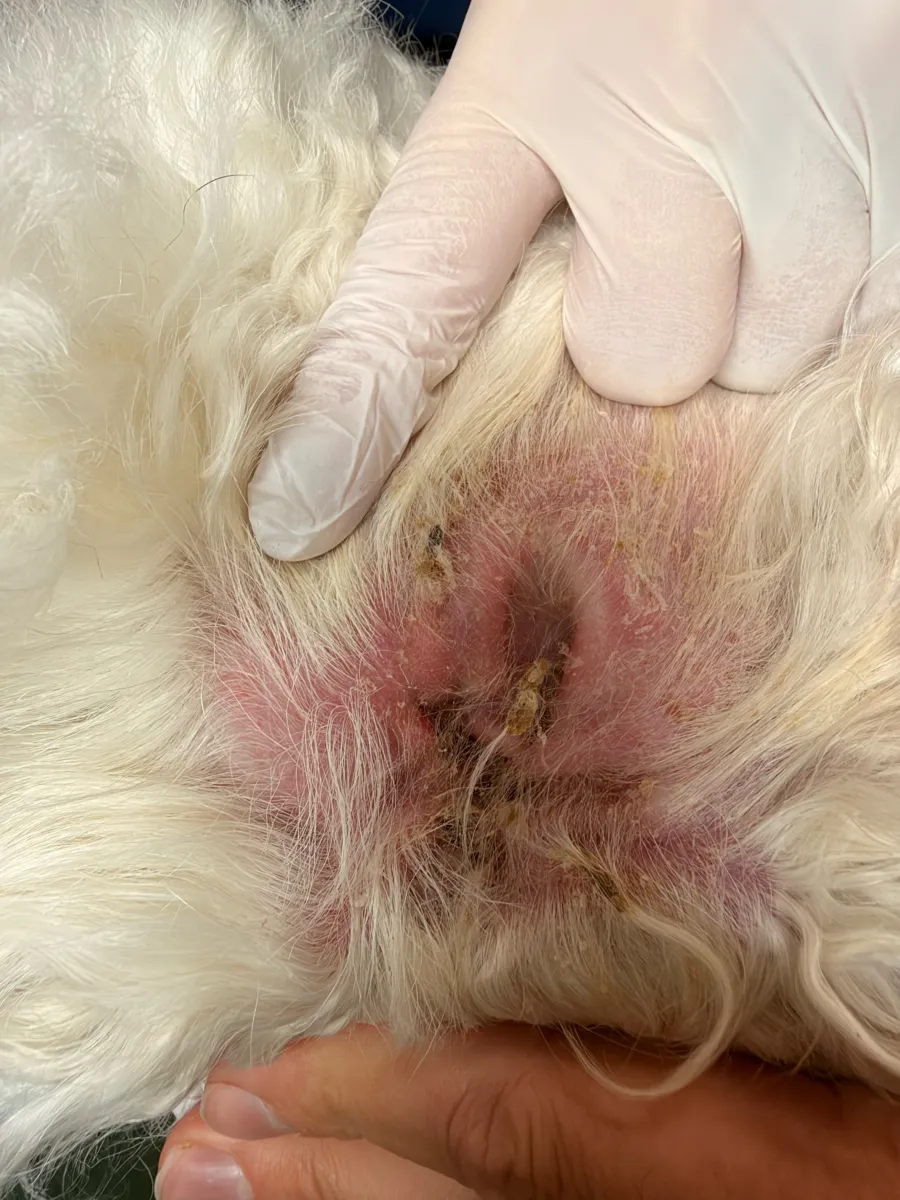
The most common signs of food allergy are itching, paw licking and recurring ear and skin infections. Some pets also have vomiting, diarrhoea or more frequent bowel movements than normal. Cats often scratch their head, face and neck, and many overgroom until bald patches appear. Food allergy is usually not seasonal, but environmental allergy is often year-round too, so year-round itching alone does not prove that food is to blame. In dogs, food allergy is more likely if the itching comes with digestive signs. It can start at any age; in almost 40% of food-allergic dogs, the signs had begun by the age of one.
Most Common Allergens
In dogs whose food allergy was confirmed with a food challenge, the most common triggers were beef (34% of dogs), dairy products (17%), chicken (15%) and wheat (13%). Less common triggers were soy (6%), lamb (5%) and corn (4%). Some dogs reacted to several foods. Cats have been studied less, but beef, fish and dairy products were their most common triggers. Wheat is the only grain among the common triggers. The figures may reflect what pets have most often been fed. “Grain-free” food is not the solution, because it often still contains the most common allergens, such as beef or chicken.
Elimination Diet — The Only Reliable Diagnostic Method
Blood tests for food allergy are not reliable: the same sample tested repeatedly gave inconsistent results, and accuracy varied greatly in dogs and was low in cats. Hair and saliva tests are not reliable either. The reliable method is an elimination diet: for at least 8 weeks, your pet eats nothing but a veterinary elimination diet, while parasites and skin infections are ruled out or treated. The diet is either a hydrolysed-protein food, in which the proteins are broken down into fragments so small that the immune system usually no longer recognises them, or a food based on a protein your pet has never eaten before. In studies, more than 90% of food-allergic dogs and cats had improved within 8 weeks.
Elimination Diet Rules
The elimination diet must be absolutely strict: your pet may have only the elimination food and water. No treats, human food, rawhide or chew bones, flavoured toothpaste, pills hidden in food, or flavoured medicines such as chewable worming or flea and tick tablets. Where possible, medicines are switched to unflavoured forms, such as spot-on parasite treatments. Make sure the whole family follows the rules and that your pet cannot scavenge, hunt or eat other pets’ food. Shop-bought “limited-ingredient” or “novel protein” foods are not suitable: in studies, 33–83% of limited-ingredient and novel-protein foods, including some veterinary ones, contained ingredients not listed on the label. Hydrolysed diets have fared better. That is why we use veterinary elimination diets and follow your pet’s response closely. If the itching does not settle, a second trial with a different diet may be needed.
Challenge Phase and Long-Term Management
If the signs improve on the elimination diet, the diagnosis is confirmed by reintroducing the old food. In studies, about half of food-allergic dogs flared up within five days and about 90% within two weeks; cats reacted faster — half within four days and about 90% within a week. Continue the challenge for a full two weeks before concluding that food is not the cause. If the signs return, your pet goes back on the elimination diet until they settle. Individual proteins can then be tested one at a time to show which are safe and which must be avoided. Food allergy cannot be cured, but avoiding the trigger foods usually keeps the signs away without medication. Some pets also have environmental allergy and may still need other treatment.
Food Allergy Investigations at Our Clinic
At Eläinklinikka Saari, we help you investigate and manage food allergy. We plan an individual elimination diet for your pet, treat secondary skin and ear infections at the same time, and follow progress throughout the process. We also sell elimination diets at the clinic and can help you choose the right one.
Sources
- Olivry T. ym. (2015): Critically appraised topic on adverse food reactions of companion animals (1): duration of elimination diets. BMC Veterinary Research 11:225. pmc.ncbi.nlm.nih.gov/PMC4551374
- Mueller R.S. ym. (2016): Critically appraised topic on adverse food reactions of companion animals (2): common food allergen sources in dogs and cats. BMC Veterinary Research 12:9. pmc.ncbi.nlm.nih.gov/PMC4710035
- Olivry T., Mueller R.S. (2017): Critically appraised topic on adverse food reactions of companion animals (3): prevalence of cutaneous adverse food reactions in dogs and cats. BMC Veterinary Research 13:51. pmc.ncbi.nlm.nih.gov/PMC5311844
- Mueller R.S., Olivry T. (2017): Critically appraised topic on adverse food reactions of companion animals (4): can we diagnose adverse food reactions in dogs and cats with in vivo or in vitro tests? BMC Veterinary Research 13:275. pmc.ncbi.nlm.nih.gov/PMC5577833
- Olivry T., Mueller R.S. (2018): Critically appraised topic on adverse food reactions of companion animals (5): discrepancies between ingredients and labeling in commercial pet foods. BMC Veterinary Research 14:24. pmc.ncbi.nlm.nih.gov/PMC5778722
- Mueller R.S., Olivry T. (2018): Critically appraised topic on adverse food reactions of companion animals (6): prevalence of noncutaneous manifestations of adverse food reactions in dogs and cats. BMC Veterinary Research 14:341. pmc.ncbi.nlm.nih.gov/PMC6233561
- Olivry T., Mueller R.S. (2019): Critically appraised topic on adverse food reactions of companion animals (7): signalment and cutaneous manifestations of dogs and cats with adverse food reactions. BMC Veterinary Research 15:140. pmc.ncbi.nlm.nih.gov/PMC6507158
- Olivry T., Mueller R.S. (2020): Critically appraised topic on adverse food reactions of companion animals (9): time to flare of cutaneous signs after a dietary challenge in dogs and cats with food allergies. BMC Veterinary Research 16:158. pmc.ncbi.nlm.nih.gov/PMC7247231
- Pagani E. ym. (2018): Cross-contamination in canine and feline dietetic limited-antigen wet diets. BMC Veterinary Research 14:283. pmc.ncbi.nlm.nih.gov/PMC6136174
- Hensel P. ym. (2015): Canine atopic dermatitis: detailed guidelines for diagnosis and allergen identification. BMC Veterinary Research 11:196. pmc.ncbi.nlm.nih.gov/PMC4531508