

Gastroscopy is an examination in which a flexible camera tube (endoscope) is passed through the mouth into the esophagus, stomach, and first part of the small intestine (duodenum). The vet sees the lining on a monitor, can take tissue samples (biopsies), and can often remove a swallowed object — without a surgical incision.
Foreign Body Removal — Often an Alternative to Surgery
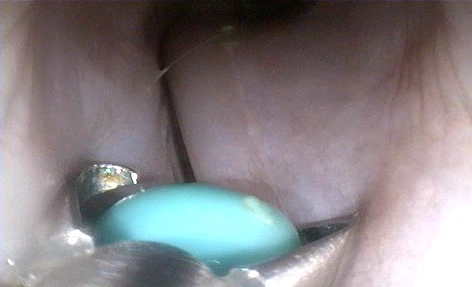
Endoscopy is usually the first choice for removing objects from the esophagus or stomach. In published studies — mostly of dogs, at university hospitals and specialist centers — the endoscope removed the object in roughly 8 to 9 cases in 10. Success depends on the object, where it lies, and the endoscopist’s experience. Dogs commonly swallow socks, other fabric, plastic, bones, and toys; cats more often string, thread, yarn, or sewing needles. If the endoscope can’t remove the object, or if string has already reached the intestine, surgery is usually needed — at Saari under the same anesthesia when possible, though the day’s schedule doesn’t always allow it.
If Your Pet Has Swallowed Something
Call a vet straight away — (06) 321 7300, or 0600 399 299 after hours. An object can move from the stomach into the intestine, out of the endoscope’s reach. The longer it stays, the more damage it can do. It is an emergency if your pet drools, gags, retches, vomits repeatedly, or keeps trying to swallow. Swallowed sharp objects (a needle, fishhook, bone splinter, or toothpick), button batteries, and multiple magnets are always emergencies. Never pull on a string or thread hanging from the mouth or bottom — pulling can tear the intestine. Don’t make your pet vomit at home unless a vet tells you to.
Investigating Chronic Digestive Symptoms
Gastroscopy is a key test when chronic vomiting, diarrhea, weight loss, or poor appetite remains unexplained after investigations such as blood and fecal tests, abdominal ultrasound, and often a diet trial. The endoscope shows ulcers, masses, and polyps, but inflammation or a tumor can only be confirmed under the microscope. Biopsies are therefore recommended during a diagnostic gastroscopy even when the lining looks normal — ideally multiple samples from the stomach and duodenum. Pathology results usually take 5–10 business days and are charged separately.
What Gastroscopy Cannot Show
Endoscopic biopsies sample only the inner lining, and the endoscope reaches only the start of the small intestine. Disease deeper in the wall or farther along the intestine can be missed. In cats, for example, lymphoma (a type of cancer) lower down may go undetected while the samples show only inflammation. Your vet may then suggest further samples, such as surgical biopsies.
The Procedure
Gastroscopy is performed under general anesthesia. Before a planned examination, your pet should have no food for about 12 hours; water is allowed until the morning of the procedure. In one study, removing a foreign body took 10 minutes to 2 hours, about an hour on average.
Advantages and Risks
There is no abdominal incision, recovery is usually quick, and most gastroscopy patients go home the same day. Serious complications are uncommon, but no procedure under anesthesia is risk-free. One of the most serious is a tear in the gut wall (perforation). In one university hospital study, this happened in about 1 in 1,000 dogs and 1 in 60 cats having a digestive-tract endoscopy, possibly more often where the wall was already diseased or ulcerated. Removing bones, or any object stuck in the esophagus, carries more risk, especially in small dogs and when the object has been there for days.
When to Contact Us
Book an appointment for ongoing or recurring vomiting, diarrhea, poor appetite, or weight loss, or for blood or mucus in the stool. If your pet vomits repeatedly, seems unwell, or may have swallowed an object, call us right away at (06) 321 7300; after hours, call the regional on-call veterinary service at 0600 399 299. One of our veterinarians has additional training in endoscopy.
Sources
- Maggi G. ym. (2023): Endoscopic Retrieval of Esophageal and Gastric Foreign Bodies in Cats and Dogs: A Retrospective Study of 92 Cases. Veterinary Sciences 10(9):560. pmc.ncbi.nlm.nih.gov/PMC10538072
- Poggiani F.M. ym. (2020): Endoscopic Removal of Foreign Body in Upper Gastrointestinal Tract in Dogs: Success Rate and Complications. Acta Scientiae Veterinariae 48:1735. seer.ufrgs.br
- Gianella P. ym. (2009): Oesophageal and gastric endoscopic foreign body removal: complications and follow-up of 102 dogs. Journal of Small Animal Practice 50(12):649–654. pubmed.ncbi.nlm.nih.gov/19954441
- Irom S. ym. (2014): Gastrointestinal perforation associated with endoscopy in cats and dogs. Journal of the American Animal Hospital Association 50(5):322–329. pubmed.ncbi.nlm.nih.gov/25028434
- Evans S.E. ym. (2006): Comparison of endoscopic and full-thickness biopsy specimens for diagnosis of inflammatory bowel disease and alimentary tract lymphoma in cats. Journal of the American Veterinary Medical Association 229(9):1447–1450. pubmed.ncbi.nlm.nih.gov/17078807
- Marsilio S. ym. (2023): ACVIM consensus statement guidelines on diagnosing and distinguishing low-grade neoplastic from inflammatory lymphocytic chronic enteropathies in cats. Journal of Veterinary Internal Medicine 37(3):794–816. pmc.ncbi.nlm.nih.gov/PMC10229359
- Rychlik A., Kaczmar E. (2020): Endoscopic Biopsies and Histopathological Findings in Diagnosing Chronic Gastrointestinal Disorders in Dogs and Cats. Veterinary Medicine International 2020:8827538. pmc.ncbi.nlm.nih.gov/PMC7568807
- Defarges A. (2024): Esophageal Foreign Bodies in Small Animals. Merck Veterinary Manual. merckvetmanual.com/esophageal-foreign-bodies-in-small-anima
- Winkler K.P. (2025): Gastrointestinal Obstruction in Small Animals. Merck Veterinary Manual. merckvetmanual.com/gastrointestinal-obstruction-in-small-an
- Gwaltney-Brant S.M. (2026): Household Hazards. Merck Veterinary Manual, Pet Owner Version. merckvetmanual.com/household-hazards
- Garneau M.S., McCarthy R.J. (2015): Multiple magnetic gastrointestinal foreign bodies in a dog. Journal of the American Veterinary Medical Association 246(5):537–539. pubmed.ncbi.nlm.nih.gov/25671286
- Catwatch / Cornell Feline Health Center (2023): When Your Cat Eats String. catwatchnewsletter.com
- ASPCA Animal Poison Control Center (2019): Is It Ever Safe to Induce Vomiting? aspca.org