

A senior cat health check, or senior check-up, is a thorough examination with blood tests — ideally including a blood pressure measurement — that aims to find age-related disease before your cat shows clear signs. Cats hide illness well, and kidney disease, an overactive thyroid, high blood pressure, dental pain and arthritis often develop so slowly that owners put the changes down to “just getting old”. Feline guidelines advise regular check-ups for older cats, and at Saari Animal Clinic we recommend a senior check-up from about 7 years of age. It costs €299, or €309 with blood pressure measurement, which we especially recommend for cats.
What does the senior check-up at Saari Animal Clinic include?
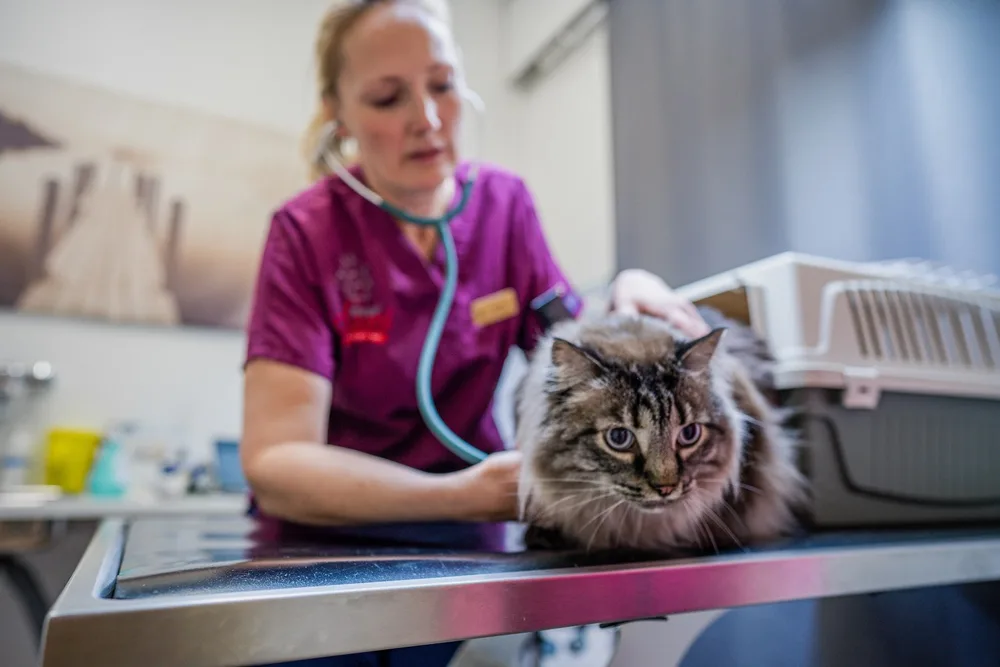
The senior check-up takes about 30–45 minutes. We go through your cat’s eating, drinking, urination, stools and sleep, and any changes you have noticed. The veterinarian examines your cat thoroughly: heart and lungs with a stethoscope, abdomen and lymph nodes, mouth and teeth, eyes, ears, skin and coat, body condition, muscles and joints, and any lumps. A blood sample is sent to the IDEXX reference laboratory for the Geriatric Profile panel, which for cats includes:
Clinical examination
- Heart and lungs
- Abdomen and lymph nodes
- Mouth and teeth
- Eyes and ears
- Skin and coat
- Body condition, muscles and joints
- Lumps
- Eating, drinking, urination, stools and sleep — what you have noticed at home
Laboratory panel IDEXX Geriatric Profile
- Complete blood count
Kidney values3
creatinine and urea, plus SDMA, an early marker of kidney diseaseElectrolytes6
sodium, potassium, chloride, calcium, magnesium and phosphateLiver values6
ALT, ALP, GGT, AST, GLDH and bilirubin- Total protein, globulins and the albumin/globulin ratio
- Glucose and fructosamine, which helps tell diabetes from a stress-related rise in blood sugar
- Cholesterol, triglycerides, CK (a muscle enzyme) and T4 (thyroid hormone)
Results are usually ready within a few days, and the veterinarian emails you a written summary: what looks good, what to monitor and concrete next steps.
- Senior check-up
- €299
- With blood pressure
- €309
Why does my cat need a check-up if it seems healthy?
Cats are very good at hiding illness and pain — the AAFP Senior Care Guidelines name the cat’s “innate ability to hide ailments” as one reason why regular examinations matter so much in older cats. The diseases of old age also develop slowly: a cat drinks a little more, loses a little weight or jumps onto the sofa less often. Changes like these are easy to put down to age, but they are often the first signs of disease, and blood values can change before anything shows at home. Comparing results from year to year also reveals trends. A kidney value that is still within the reference range but higher than last year says more than a single number. Early diagnosis matters: in cats with established kidney disease, a kidney diet has been shown to reduce uraemic crises and lengthen survival.
At what age is a cat a senior, and how often does it need a check-up?
The 2021 AAHA/AAFP Feline Life Stage Guidelines call cats aged 7–10 years “mature adults” and cats over 10 years “seniors”. Many age-related diseases, kidney disease among them, can begin before a cat reaches the senior stage, so we recommend a senior check-up from about 7 years of age. After that:
- Healthy older cats: once a year.
- Cats with a chronic disease (kidney, heart or thyroid disease, or diabetes): on a plan agreed with the vet, often every 3–6 months.
Which diseases does a senior check-up look for?
The main age-related diseases in cats are:
- Chronic kidney disease — common in older cats, and it can begin in middle age; see Chronic kidney disease.
- Hyperthyroidism (overactive thyroid) — affects about 10% of cats over 10 years of age; see Hyperthyroidism in cats.
- High blood pressure — usually caused by kidney or thyroid disease (more below).
- Dental disease, including painful tooth resorption — the risk of both rises with age. Tooth resorption is easily missed in an awake cat, and confirming it often needs dental X-rays under anaesthesia.
- Osteoarthritis — degenerative joint disease affects up to 74% of cats aged 12 or older, yet many affected cats are never diagnosed or treated. Never give your cat human painkillers: paracetamol and ibuprofen are poisonous to cats.
- Diabetes — a common hormonal disease in senior cats.
- Heart disease — hypertrophic cardiomyopathy (HCM) affects an estimated 15% of cats overall and up to 29% of older cats. Many cats with HCM have no heart murmur. A normal examination does not rule it out; a heart ultrasound is the test for it.
- Weight and muscle loss — common in older cats, but unexplained weight loss always needs investigating.
Which signs of illness in an older cat do owners often miss?
Watch for these small, gradual changes:
- drinking more, bigger clumps in the litter tray, urinating outside it, or constipation
- weight loss — especially if your cat is eating as well as before, or even more
- jumping less often or not as high, or hesitating before a jump
- a dull, unkempt or matted coat — a cat in pain grooms less
- yowling at night, being restless or seeming confused
- bad breath, drooling or pawing at the mouth
- hiding, sleeping more or losing interest in people and play
- eating less or vomiting more often
Night-time yowling, for example, can be caused by failing sight or hearing, cognitive decline, pain, an overactive thyroid or high blood pressure. Write down what you see, or film your cat at home: what you tell us is often as important as what we find in the examination. If you notice any of these changes, book an appointment — don’t wait for the next yearly check-up.
Why should an older cat’s blood pressure be measured?
High blood pressure (hypertension) is much more common in cats over 10, and it often goes unnoticed until it has caused damage. In most cats it is caused by another disease; kidney disease and an overactive thyroid are the most common causes. According to the ISFM consensus guidelines, 19–65% of cats with chronic kidney disease, and 10–23% of cats newly diagnosed with hyperthyroidism, have high blood pressure. Untreated, it can damage the eyes, kidneys, heart and brain, and some of that damage may be permanent. Eye changes have been reported in about half of cats diagnosed with hypertension, and blindness caused by retinal detachment is often permanent. The guidelines recommend measuring blood pressure at least yearly in healthy cats aged 7–10, at least every 6–12 months from 11 years, and at least every 3–6 months in cats with kidney or thyroid disease. Stress can raise a cat’s blood pressure temporarily, so we measure it calmly while your cat is awake, using cuffs sized for cats. High blood pressure should be confirmed with repeated measurements, not diagnosed from a single reading.
Does my older cat need a urine test too?
The AAHA/AAFP guidelines recommend a urine test as part of routine screening for cats aged 7–10, and strongly recommend it for cats over 10. It is not included in the €299/€309 senior check-up, so the veterinarian suggests one when it is useful — especially when kidney values are borderline or rising. Two results matter most:
- Urine specific gravity (USG) shows how well the kidneys concentrate urine. In cats, dilute urine can be an early sign of kidney disease, even while creatinine is still normal.
- Urine protein:creatinine ratio (UPC) measures protein leaking into the urine. The international IRIS guidelines use it, together with blood pressure, to classify kidney disease, and persistent protein loss is linked to shorter survival in affected cats.
A urine test also detects sugar in diabetes and evidence of urinary tract infection, which is more common in cats with kidney disease; a urine culture can find bacteria that cause no visible signs. If we recommend a urine test, you will get a clear price estimate first — nothing is done without your consent.
How can I make the vet visit less stressful for my cat?
Saari Animal Clinic is an ISFM Cat Friendly Clinic at Silver level. In 2020 we became the first Cat Friendly Clinic in Ostrobothnia. Cats wait in an area screened from dogs, with raised shelves and covers for carriers, and are examined in a cat-only consulting room. Feliway diffusers in reception and the waiting area, and Feliway spray on tables and towels, help cats settle. We never scruff cats, and a cat in pain is given pain relief before the examination. Our cat advocate is Pamela Kvarngård. At home you can help:
- Leave the carrier out all the time, with the door open and soft bedding inside, so it becomes a familiar resting place.
- Spray Feliway into the carrier at least 15 minutes before your cat goes in, so the alcohol can evaporate.
- Cover the carrier with a towel and keep it stable in the car — on the floor behind the front seats.
- A carrier with a removable top is ideal: many cats feel safest in its bottom half.
For a very anxious cat, calming medication before the visit can be discussed with the vet in advance. Read more: A less stressful vet visit for your cat.
How much does a senior check-up for a cat cost?
At Saari Animal Clinic the senior check-up costs €299. This covers the veterinary visit, blood sampling, the IDEXX Geriatric Profile panel and the veterinarian’s interpretation of the results. With blood pressure measurement, which we especially recommend for cats, the price is €309. A dental check on its own, without anaesthesia, costs €32; during dental treatment under anaesthesia we usually also take full-mouth dental X-rays. If the check-up shows that further tests are needed — a urine test, dental X-rays or a heart ultrasound — you will get a clear price estimate first. A heart ultrasound (echocardiography) for a cat costs €376–476. It is done here at the clinic by our veterinarian Leena Sandström, a heart examiner authorised by the Finnish Kennel Club who holds an ESAVS cardiology certificate, so there is no need to travel to another city. See cardiac examinations. You will find our other prices in the price list.
When should I take my older cat to the vet, and how do I book in Vaasa?
Book a senior check-up when your cat is about 7 years old, then once a year — or sooner if you notice any of the changes above. Some signs are emergencies. Call us straight away if your cat breathes fast or with effort at rest, suddenly cannot use its hind legs, or strains in the litter tray without passing urine (a blocked bladder, especially in male cats, and often mistaken for constipation). If your cat suddenly goes blind or has not eaten for more than a day, it also needs to see a vet the same day. Outside our opening hours, call the Northern emergency-area number 0600 399 299. You can book online or call us on (06) 321 7300. Choose a morning appointment and fast your cat for about 8–12 hours before the blood sample; water is fine, and give your cat its usual medication as normal unless agreed otherwise. If your cat has diabetes, agree with the vet in advance how to time food and insulin on the day.
Sources
- Quimby J, Gowland S, Carney HC, ym. 2021 AAHA/AAFP Feline Life Stage Guidelines. J Feline Med Surg 2021;23(3):211–233. pmc.ncbi.nlm.nih.gov
- Ray M, Carney HC, Boynton B, ym. 2021 AAFP Feline Senior Care Guidelines. J Feline Med Surg 2021;23(7):613–638. pmc.ncbi.nlm.nih.gov
- Taylor SS, Sparkes AH, Briscoe K, ym. ISFM Consensus Guidelines on the Diagnosis and Management of Hypertension in Cats. J Feline Med Surg 2017;19(3):288–303. pmc.ncbi.nlm.nih.gov
- International Renal Interest Society. IRIS Staging of CKD (modified 2026). iris-kidney.com
- Luis Fuentes V, Abbott J, Chetboul V, ym. ACVIM consensus statement guidelines for the classification, diagnosis, and management of cardiomyopathies in cats. J Vet Intern Med 2020;34(3):1062–1077. pmc.ncbi.nlm.nih.gov
- Rodan I, Dowgray N, Carney HC, ym. 2022 AAFP/ISFM Cat Friendly Veterinary Interaction Guidelines: Approach and Handling Techniques. J Feline Med Surg 2022;24(11):1093–1132. pmc.ncbi.nlm.nih.gov
- Merck Veterinary Manual. Toxicoses From Human Analgesics in Animals. merckvetmanual.com