

Every summer, people find a tiny hedgehog alone in the garden, on a path or out in daylight — and their first instinct is to scoop it up and help. Sometimes that instinct saves a life. Sometimes it accidentally orphans a healthy baby whose mother was only metres away. This guide will help you tell the difference, and show you exactly what to do — the Finnish way, and within Finnish law.
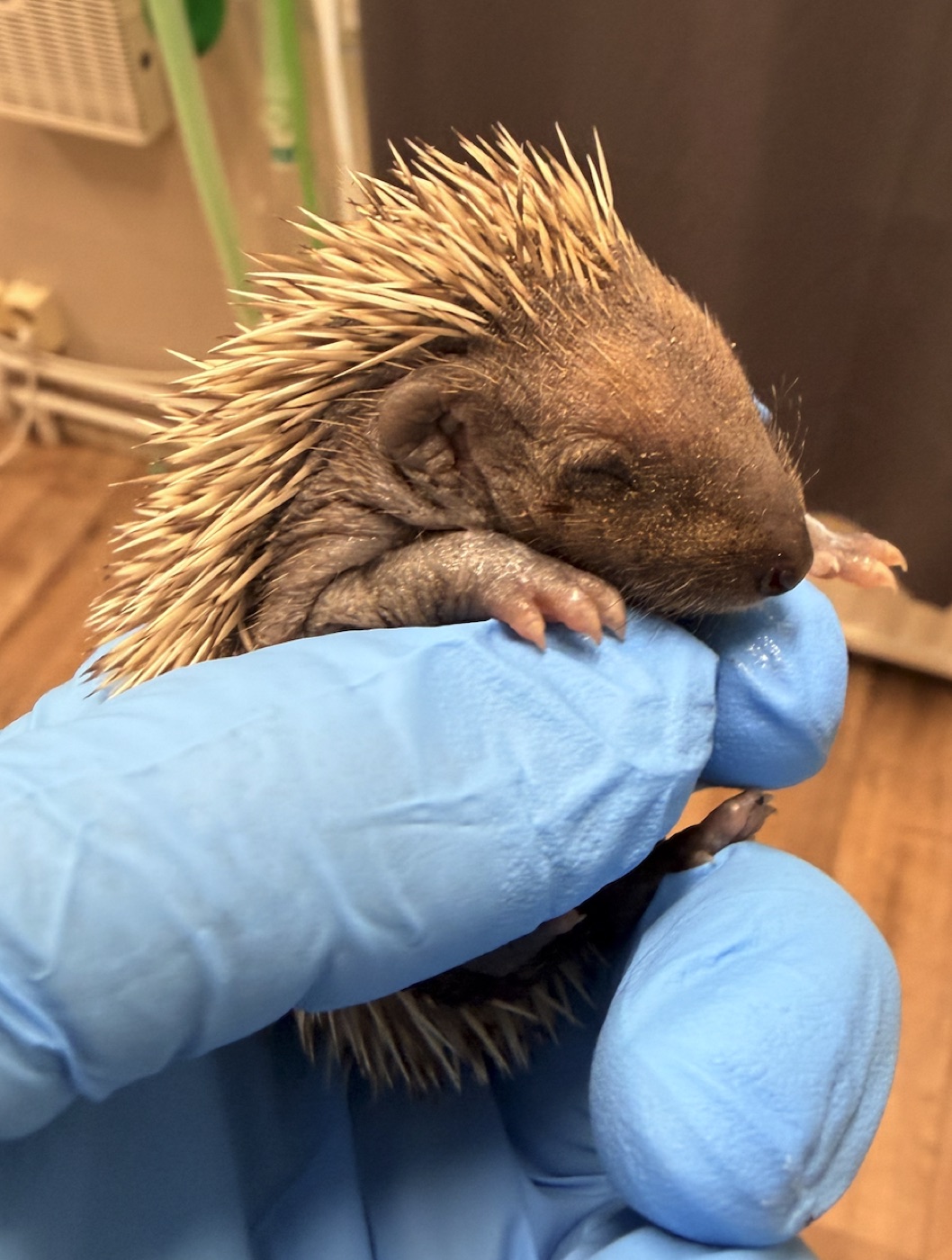
This hoglet — eyes still closed, brought in to Saari Animal Clinic — is exactly the kind of tiny baby that cannot survive on its own. Photo: Eläinklinikka Saari.
First, the most important rule
In Finland the hedgehog (siili, Erinaceus europaeus) is a protected species under the Nature Conservation Act (9/2023, § 69). The Animal Welfare Act, however, requires that a sick, injured or otherwise helpless wild animal be helped (693/2023, § 7). Anyone may take one in without a permit — but only briefly, to give it first aid or take it for treatment (Nature Conservation Act § 71; Animal Welfare Act § 29). A wild hedgehog may never be kept as a pet (Animal Welfare Act § 28).
In practice: don’t “rescue” a hoglet on impulse. Look first, from a distance, and check the signs below. If you are still unsure, call us during our opening hours before you pick it up; outside those hours, see “Who to call”. A small hedgehog on its own is often not an emergency: even before they are weaned, hoglets spend part of their time moving about alone, returning to their mother to suckle. Rescue centres receive many young hedgehogs that never needed help. In a large Czech study, the heavier the youngster, the more often it had been taken in needlessly — while nearly all of the very smallest babies genuinely needed care.
Is this baby actually in trouble?
Finnish hedgehogs are born in midsummer — pink, blind and helpless — and spend their first weeks in the nest. At about three to four weeks old, they start to leave the nest with their mother, and at about five to six weeks — in Finland usually in early August — they are weaned, weighing only about 120–350 g. A healthy weaned youngster behaves like a small adult: it huffs, curls into a tight ball and moves briskly. Leave it be.
A hoglet genuinely needs help if:
- It is out in the open in the daytime, or lying still in the open for long stretches. Hedgehogs are nocturnal, and a healthy one does not lie still out in the open.
- It is cold to the touch, limp or wobbly.
- It is squeaking persistently in the open, with no adult nearby.
- It is circling, staggering or moving abnormally.
- There are flies around it, or fly eggs or maggots on it — fly eggs look like tiny grains of rice. This is an emergency.
- Its eyes are still closed and it is outside the nest. A hoglet this young belongs in the nest and cannot survive without its mother.
- Several babies are wandering together with no mother — they very likely need help, because something has probably happened to her, such as a road accident. If you find one hoglet that needs help, look around for siblings.
- It is late September or later and the hedgehog is well under about 600 g — it is unlikely to survive Finland’s long hibernation without help, especially if it is out in the daytime. In late summer, though, small hedgehogs are often healthy juveniles, so don’t catch a healthy-looking one just to weigh it.
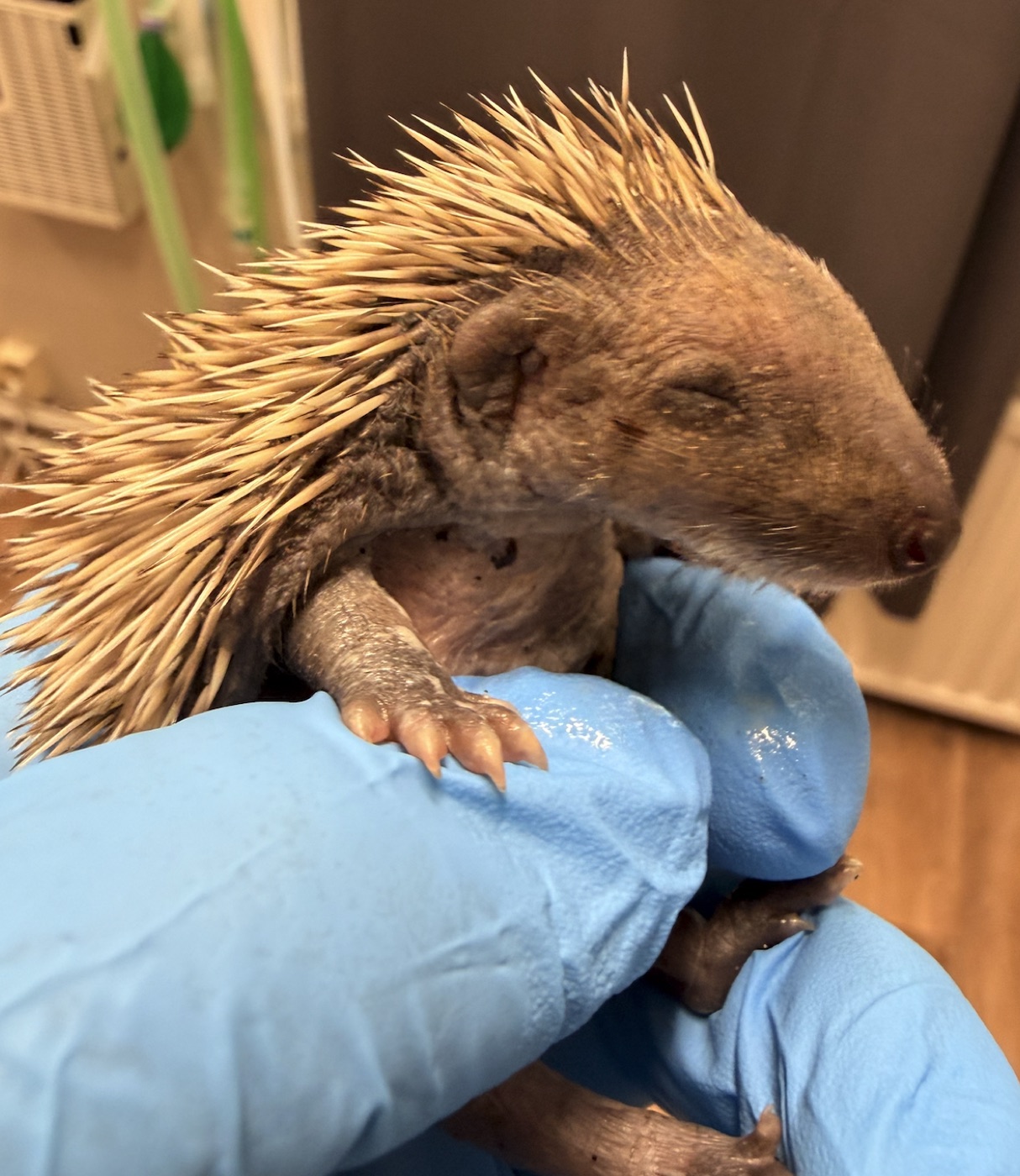
Still too young to be alone: at this age a hoglet’s spines are soft and pale, and its eyes are not yet open. Photo: Eläinklinikka Saari.
Could the mother come back for it?
Sometimes. A mother whose nest is disturbed may carry her young in her mouth to a new site. But disturbance is dangerous in itself: especially in the first days after birth, a frightened mother may abandon or even kill her young.
If you have accidentally uncovered a nest, carefully cover it back over, move away and watch from a distance. If the babies stay in the nest, leave them in peace and don’t keep checking on them. If the mother was hurt, or hoglets come out of the nest squeaking, they need help — see below.
If you see a single lively youngster with its eyes open, moving about at dusk or at night, it is probably not an orphan: watch from a distance and leave it alone. Mothers are active mainly after dark, though a nursing mother may briefly come out in daylight to find food.
But don’t leave a baby out waiting for a mother who may never come — not if its eyes are closed, it feels cold, or it is out in the open in the daytime. A tiny hoglet cannot keep itself warm, and away from its mother and siblings it cools quickly — cold is the clock. Handle hedgehogs only when you need to, and wear thick gloves.
What to do right now (before you bring it in)
For a tiny hoglet, cold is the most urgent danger. While you arrange care:
- Warm it — this is the priority. Fill a hot-water bottle with hot tap water — never boiling water — and wrap it in a towel: you should be able to rest your hand on the wrapped bottle comfortably. Put the bottle in a high-sided box, lay the hoglet on top and cover it with a small towel, leaving room for it to crawl off the bottle if it gets too warm. Refill the bottle before it cools — a bottle left to go cold does more harm than good. A cold baby cannot digest food, so warmth comes before anything else.
- No added heat if it is bleeding or has fly eggs or maggots — it needs a vet right away (see below). In hot weather, extra heat may not be needed unless the hoglet feels cool.
- Keep it contained, somewhere dim and quiet. Use a cardboard box with air holes and an old towel or fleece on the bottom, and keep it indoors in a quiet room: dim, peaceful surroundings calm a frightened wild animal. Wear gloves, and wash your hands with soap afterwards — hedgehogs often carry Salmonella without showing any signs.
- Do NOT give milk. Ever. Hedgehogs are lactose intolerant: cow’s milk gives them diarrhoea and stomach pain that gradually weaken them.
- Don’t try to hand-feed a tiny baby yourself. A cold, dehydrated newborn must be warmed and rehydrated before it is given any special milk formula, and hand-rearing hoglets is specialist work. The wrong food, or food given too early, can kill it.
If it is an older, weaned youngster that is simply thin and hungry — not a baby still on its mother’s milk — let it warm up first. Then you can offer a shallow dish of water and a little meaty cat food (not fish) or soaked dry cat food. But for a tiny baby, warmth plus a phone call is the whole job.
Who to call
Call us at (06) 321 7300 and bring the hoglet — and any siblings — to Eläinklinikka Saari (Gerbyntie 18, Vaasa). We give first aid, and SiiliSaari Care Center, the hedgehog rehabilitation centre run by our clinic, takes over their ongoing care. When you call, tell us how many babies there are, whether their eyes are open, roughly how big they are, where you found them and how they are doing.
We are open Monday–Friday 7:45–17:00. Outside our opening hours, call the after-hours vet at 0600 399 299 if the hoglet is bleeding, has fly eggs or maggots, or has collapsed. Call that number, too, for any baby too young to eat on its own, above all one with its eyes still closed. A baby still on milk needs feeding every few hours — a newborn every two to three — so it cannot safely wait until we open. If you are not sure which it is, treat it as a baby. Only a weaned youngster that eats on its own can wait until we open, kept warm in its box in a quiet place.
National advice is also available:
- Korkeasaari Wildlife Hospital (Villieläinsairaala), Helsinki — Finland’s largest care centre for injured and orphaned wild animals. Its phone service, open daily in the daytime, advises on whether an animal needs help, wherever you are in Finland. See korkeasaari.fi.
- SEY Suomen eläinsuojelu — the Finnish animal welfare association, whose website has advice on hedgehogs and a list of wildlife helpers around Finland. See sey.fi.
Why it’s worth the effort
A young hedgehog’s first winter is brutal. According to SEY, an estimated 30% or more of young hedgehogs — sometimes as many as 80% — die in their first winter, often because their fat reserves are too small or their nest is damaged. Babies from late litters have the least time to fatten up. Advice on the minimum weight before hibernation varies: the British Hedgehog Preservation Society gives about 450 g as the absolute minimum, SEY recommends at least about 600 g, and the Finnish Association for Nature Conservation (SLL), 800 g. An underweight youngster found in autumn is exactly the kind of hedgehog SiiliSaari Care Center can help. Once it has gained enough weight, it is released where it was found, if that spot is safe and there is still time for it to make its own winter nest. Otherwise, it is released into a ready-made nest to hibernate. Hedgehog numbers are falling across much of Europe: in October 2024 the IUCN moved the hedgehog from Least Concern to Near Threatened on its global Red List (see our article on the hedgehog in Europe and Finland). So every one we get right matters.
The short version
- Don’t grab on impulse — a lively, open-eyed youngster alone at dusk or at night is probably not an orphan.
- Eyes closed and out of the nest, cold, lying still or squeaking in the open, or out by day? Flies around it, or fly eggs or maggots on it? It needs help now.
- Warm it on a towel-wrapped hot-water bottle in a box in a quiet room — unless it is bleeding or has fly eggs or maggots, in which case it needs a vet at once.
- No milk. No do-it-yourself feeding of tiny babies.
- Call us at (06) 321 7300 (Mon–Fri 7:45–17:00) and bring it in. Outside our opening hours, call the after-hours vet at 0600 399 299 for bleeding, fly eggs or maggots, collapse, or a baby too young to eat on its own, above all one with closed eyes. If unsure, treat it as a baby; only a weaned, self-feeding youngster can wait.
When in doubt, call before you decide. We would always rather take a call than treat a mistake.
Sources
- Nature Conservation Act 9/2023 (Finlex): § 69 protected species and § 71 protected animals found sick, injured or helpless. finlex.fi/9
- Animal Welfare Act 693/2023 (Finlex): § 7 duty to help a helpless wild animal, § 28 ban on keeping wild vertebrates and § 29 short-term care of a helpless wild animal. finlex.fi/693
- IUCN (2024): Western European hedgehog moved from Least Concern to Near Threatened — Red List update, 28 October 2024. iucn.org
- Korkeasaari Wildlife Hospital: FAQ on hedgehogs — when a hoglet needs help, weaning in early August, signs of illness and transport. korkeasaari.fi/siilit
- Korkeasaari Wildlife Hospital: Villieläinsairaala — Finland’s largest care centre for injured and orphaned wild animals; phone advice every day from 8 am, wherever you are in Finland. korkeasaari.fi/villielainsairaala
- SEY Suomen eläinsuojelu: Species-specific questions — hedgehog (weaning age and weight, hoglets alone before weaning, groups of hoglets, milk, first-winter mortality). sey.fi/lajikohtaisia-kysymyksia-siili
- SEY Suomen eläinsuojelu: Hedgehog — daytime activity, lying still in the open, Salmonella and pre-hibernation weight. sey.fi/siili-2
- SEY Suomen eläinsuojelu: Wild animal in distress — contacts for wildlife helpers around Finland. sey.fi/luonnonelain-hadassa
- Finnish Association for Nature Conservation (SLL): Five ways to help hedgehogs. sll.fi
- Mustasaari municipality, West Coast environmental unit (Länsirannikon ympäristöyksikkö): Veterinary on-call service — northern on-call area 0600 399 299 (Laihia, Mustasaari, Vaasa, Vähäkyrö, Vöyri), weekdays 16–8 and Friday 16 to Monday 8. mustasaari.fi
- British Hedgehog Preservation Society: Hedgehog first aid advice. britishhedgehogs.org.uk/found-a-hedgehog
- British Hedgehog Preservation Society: Frequently asked questions — hedgehogs out in daylight. britishhedgehogs.org.uk/faq
- British Hedgehog Preservation Society: Autumn juveniles — weight for hibernation. britishhedgehogs.org.uk/autumn-juveniles
- Hedgehog Street (BHPS & PTES): Found a sick or injured hedgehog? — hoglets. hedgehogstreet.org/sick-or-injured-hedgehog
- Hedgehog Street (BHPS & PTES): Summer FAQ — disturbed nests. hedgehogstreet.org/summer-faq
- Hedgehog Street (BHPS & PTES): Breeding, babies, hoglets. hedgehogstreet.org/hoglets
- Hedgehog Street (BHPS & PTES): Daytime hoglets. hedgehogstreet.org/daytime-hoglets
- Lukešová G. ym. (2021): Juvenile European hedgehogs (Erinaceus europaeus) at rescue centers and their release rate depending on their weight on admission. PLoS ONE 16(10):e0258273. pmc.ncbi.nlm.nih.gov/PMC8496866
- Kadlecova G. ym. (2023): Differences in Mortality of Pre-Weaned and Post-Weaned Juvenile European Hedgehogs (Erinaceus europaeus) at Wildlife Rehabilitation Centres in the Czech Republic. Animals 13(3):337. pmc.ncbi.nlm.nih.gov/PMC9913465
- Hand A. (2020): Hedgehogs – a practical approach to common presentations. Veterinary Ireland Journal 10(7):374–378. veterinaryirelandjournal.com