

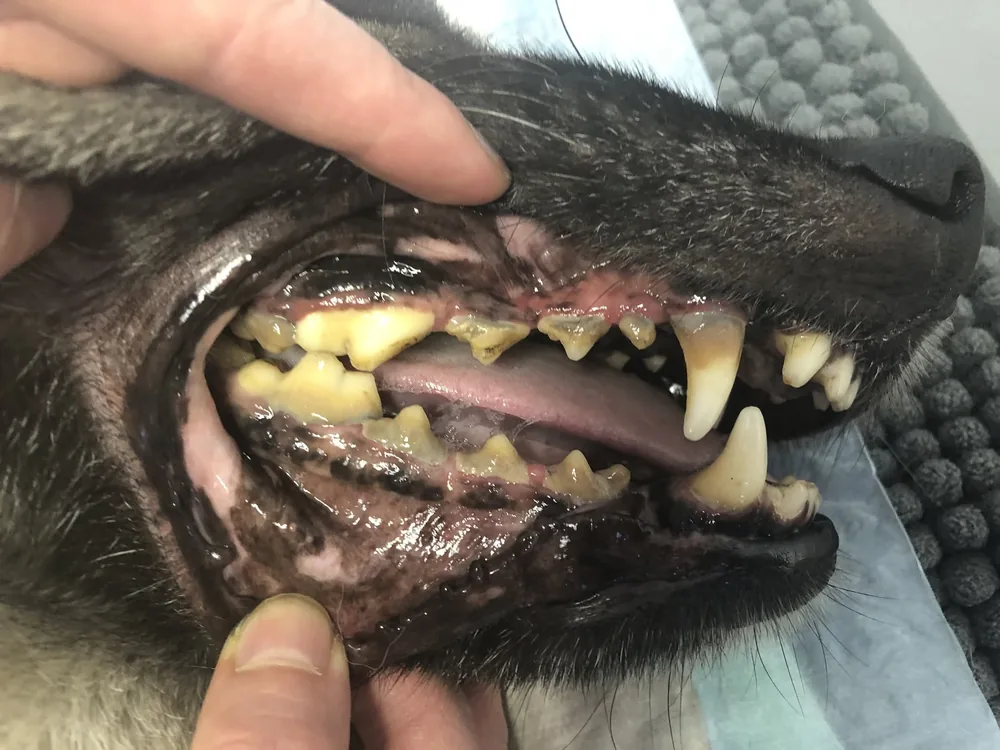
Gum (periodontal) disease is one of the most common health problems in dogs and cats. Thorough examinations under anesthesia find at least early gum disease in most adult pets, often by two to three years of age. It causes pain and infection and has been linked to heart, kidney and liver disease. Daily tooth brushing is the most effective way to prevent it at home — and many pets learn to accept it.
Why Daily?
Plaque — a sticky film of bacteria — re-forms within a day of cleaning and within a few days starts hardening into tartar, which brushing cannot remove. Plaque at and just below the gumline is what inflames the gums; daily brushing keeps ahead of it. In studies in dogs, more frequent brushing worked better: in one, brushing every other day was not enough to keep the gums healthy, and in another, gum inflammation was back after four weeks without brushing.
How to Brush Your Pet’s Teeth
Always use pet toothpaste. Pets swallow the paste, and human toothpastes usually contain foaming agents and fluoride that can upset the stomach; some also contain xylitol, which is poisonous to dogs. Use a soft brush sized to the mouth — a children’s toothbrush often fits smaller dogs, and an infant brush often suits cats and toy breeds. A finger brush helps while your pet is learning. Lift the lip, angle the bristles at about 45 degrees toward the gumline and brush in small circles. Brush the outer surfaces first, with the mouth closed, sliding the brush inside the cheek to reach the back teeth. If your pet allows, brush the inner surfaces too. It all takes less than 2 minutes.
Getting Your Pet Used to Brushing
Go at your pet’s pace; the week-by-week steps are only a guide. Week 1: touch the lips and teeth with your finger. Week 2: let your pet lick toothpaste from your finger, then rub a little on the front teeth. Week 3: introduce the brush and brush a few teeth, then gradually more. Always reward your pet afterward. Never force the mouth open; keep sessions short and positive, and stop if your pet becomes stressed or tries to bite. Start handling practice while your pet is a puppy or kitten, and begin daily brushing once the adult teeth are in (at about 6–7 months). Adult pets can learn too. If your pet already has tartar, red gums or bad breath, book a dental check first.
Signs of Dental Disease
Watch for bad breath (it is not normal); red, swollen or bleeding gums; and visible tartar. Other signs include dropping food, chewing on one side only, drooling, pawing at the mouth, facial swelling, reluctance to have the head touched, behavioral changes and weight loss. Animals hide pain: many keep eating even when the mouth hurts badly, so a normal appetite does not mean a healthy mouth. After treatment, pets may become livelier, sleep better or even become friendlier.
Professional Dental Cleaning
Even with good home care, many pets, especially older ones, need professional cleaning under general anesthesia from time to time. We recommend a dental check at least once a year; a quick check without anesthesia helps us assess whether treatment is needed. Under anesthesia we clean below the gumline, where gum disease is active. We also examine every tooth and usually take dental X-rays: in studies of pets referred for dental treatment, X-rays of normal-looking teeth revealed important problems in more than one in four dogs and about four in ten cats. General anesthesia is essential: so-called “anesthesia-free dental cleaning” is purely cosmetic, cannot treat disease below the gumline and gives a false sense of security.
What Else Helps?
Dental chews and diets can help, but less than brushing. Look for the VOHC (Veterinary Oral Health Council) seal, awarded when trials show a product slows the buildup of plaque or tartar. Choose the right size of chew and supervise chewing; avoid very hard chews such as antlers, hooves or nylon bones, which can break teeth. We sell pet toothpaste and soft toothbrushes for dogs and cats.
#BrushChamp — Do You Brush Every Day?
At Eläinklinikka Saari we value owners who commit to daily tooth brushing. If you brush your pet’s teeth every day, let us know — dedicated brushers receive the #BrushChamp medal! Contact us at the clinic or by email: info@saarivet.fi.
Sources
- Niemiec B, Gawor J, Nemec A, Chandler M, Mestrinho LA, Steagall PV, Papadimitriou S, Ong BHE, Morgenegg G, McLeod K, Burley M (2026) World Small Animal Veterinary Association global dental guidelines. Journal of Small Animal Practice, published online 2 September 2026. doi:10.1111/jsap.70057 doi.org/jsap.70057
- WSAVA Global Dental Committee (2022) Introducing Toothbrushing — Client Handout. wsava.org
- American Veterinary Dental College (2024) AVDC Position Statement on Anesthesia-Free Dentistry (AFD). Adopted April 2024. avdc.org/dental-scaling-without-anesthesia.pdf
- American Veterinary Dental College (AVDC): Animal Owner Resources — Why does my pet have stinky breath? avdc.org/animal-owner-resources
- Veterinary Oral Health Council (VOHC): What does the VOHC do? / Keeping your Pets Healthy & Safe / How Can I Prevent Dental Disease in My Pet? vohc.org
- U.S. Food and Drug Administration (2025) Paws Off Xylitol; It’s Dangerous for Dogs. Consumer Update, content current as of 17 December 2025. fda.gov
- Harvey C, Serfilippi L, Barnvos D (2015) Effect of frequency of brushing teeth on plaque and calculus accumulation, and gingivitis in dogs. Journal of Veterinary Dentistry 32(1):16–21. doi:10.1177/089875641503200102 doi.org/089875641503200102
- Gorrel C, Rawlings JM (1996) The role of tooth-brushing and diet in the maintenance of periodontal health in dogs. Journal of Veterinary Dentistry 13(4):139–143. doi:10.1177/089875649601300405 doi.org/089875649601300405
- Ingham KE, Gorrel C (2001) Effect of long-term intermittent periodontal care on canine periodontal disease. Journal of Small Animal Practice 42(2):67–70. doi:10.1111/j.1748-5827.2001.tb01994.x doi.org/j.1748-5827.2001.tb01994.x
- Pavlica Z, Petelin M, Juntes P, Eržen D, Crossley DA, Skalerič U (2008) Periodontal disease burden and pathological changes in organs of dogs. Journal of Veterinary Dentistry 25(2):97–105. doi:10.1177/089875640802500210 doi.org/089875640802500210
- Wallis C, Holcombe LJ (2020) A review of the frequency and impact of periodontal disease in dogs. Journal of Small Animal Practice 61(9):529–540. doi:10.1111/jsap.13218 doi.org/jsap.13218
- Kortegaard HE, Eriksen T, Baelum V (2008) Periodontal disease in research beagle dogs — an epidemiological study. Journal of Small Animal Practice 49(12):610–616. doi:10.1111/j.1748-5827.2008.00609.x doi.org/j.1748-5827.2008.00609.x
- Girard N, Servet E, Biourge V, Hennet P (2009) Periodontal health status in a colony of 109 cats. Journal of Veterinary Dentistry 26(3):147–155. doi:10.1177/089875640902600301 doi.org/089875640902600301
- Verstraete FJM, Kass PH, Terpak CH (1998) Diagnostic value of full-mouth radiography in dogs. American Journal of Veterinary Research 59(6):686–691. doi:10.2460/ajvr.1998.59.06.686 doi.org/ajvr.1998.59.06.686
- Verstraete FJM, Kass PH, Terpak CH (1998) Diagnostic value of full-mouth radiography in cats. American Journal of Veterinary Research 59(6):692–695. doi:10.2460/ajvr.1998.59.06.692 doi.org/ajvr.1998.59.06.692