The European hedgehog (Erinaceus europaeus) is one of our most beloved wild animals — and its numbers are falling across much of Europe. In October 2024, the IUCN moved the hedgehog from Least Concern to Near Threatened on its global Red List. Populations are thought to have shrunk in more than half of the countries where it lives. In many parts of its range, the decline appears to be approaching — or even exceeding — 30% over ten years, the threshold for a threatened category. In Finland, the hedgehog lives at the northern edge of its range, where long winters make survival especially hard. In this article, we look at the hedgehog’s situation, the threats it faces and how everyone can help.
Declining Across Europe
According to the IUCN, national declines are estimated at 16–33% over the past ten years, and local studies report losses of up to 50% in Bavaria (Germany) and Flanders (Belgium). According to the State of Britain’s Hedgehogs 2022 report, rural populations in Great Britain fell by between a third and three-quarters over two decades, and the 2020 Red List for Britain’s Mammals classifies the hedgehog as Vulnerable. In the Netherlands, numbers fell by 25–50% between 1994 and 2018. Sweden’s 2025 Red List moved the hedgehog from Near Threatened to Vulnerable after an estimated 48% decline over 12 years, and Norway has listed it as Near Threatened since 2021. A 2025 review in Biological Conservation found Europe’s hedgehog species to be declining, too poorly monitored to assess reliably, or both. In March 2025, the University of Oxford reported that one of the review’s authors was working with the European Parliament on an EU-wide hedgehog conservation strategy.
The Hedgehog in Finland
In Finland, the hedgehog reaches the northern edge of its range: its continuous distribution extends roughly to the Tornio–Kuhmo line, with only occasional sightings farther north. The hedgehog is a protected species under the Nature Conservation Act (9/2023, § 69). In the 2019 Finnish Red List assessment, it was classified as Least Concern (LC). However, there are no accurate data on hedgehog numbers in Finland, and according to a Finnish hedgehog researcher, reported road deaths and sightings suggest a decline here too. The short northern summer leaves little time to mate, raise young and build up fat before a long hibernation. In eastern Finland, radio-tracked hedgehogs hibernated for about 223 days — more than seven months, the longest hibernation reported for the species. In Finland, hedgehogs live mainly near people — in yards, parks and gardens.
Why Are Hedgehogs Declining?
Most of the main threats are human-caused. Traffic kills hundreds of thousands of hedgehogs in Europe every year: studies from the late 1990s estimated 113,000–340,000 road deaths a year in the Netherlands and 230,000–350,000 in Belgium. Solid fences and walls fragment habitat and stop hedgehogs from moving between gardens. Agricultural intensification, pesticides and insect decline reduce their food supply. In a Danish study published in 2024, rodenticide residues were found in 84% of 115 dead hedgehogs, insecticides in 43% and herbicides in 50% — though it is not yet known whether these levels harm hedgehogs. Mild, unstable winters can also be a problem: in warm spells, hibernating hedgehogs burn fat faster and may wake more often, and every awakening uses up reserves they need to last until spring.
Robot Lawn Mowers — A Growing Threat
Robot lawn mowers are a growing — and preventable — threat to hedgehogs. In a 2024 study, researchers from the University of Oxford, Danish universities and Germany’s Leibniz Institute for Zoo and Wildlife Research tested 19 robot mower models on dead hedgehogs. Some models caused injuries and others did not; in all but one case, the mower had to physically touch the hedgehog before detecting it. In Germany, 71 hedgehog care centers reported 370 hedgehogs with cut injuries from garden equipment over 16 months in 2022–2023; at least 47% died or had to be euthanized. According to the study, many of these injuries may have been caused by robot mowers — and many injured hedgehogs are never found. Hedgehogs are active at night, and curling into a ball does not protect them from the blades. The most important message: run robot mowers only in daylight — never at dusk or at night.
How Can You Help Hedgehogs?
Make a hedgehog highway: a 13 × 13 cm hole at the bottom of your fence lets hedgehogs move between gardens, and connecting gardens is one of the most effective things you can do. Never run robot mowers after dusk. Leave wild corners in your garden — leaf piles, log piles and brush heaps provide food, shelter and nesting sites. Provide fresh water in a shallow dish. As supplementary food, especially in autumn, offer meat-based cat food (not fish) or soaked dry cat food. Never give milk — hedgehogs are lactose intolerant, and it gives them diarrhea. Skip bread, too: it has almost no nutritional value for them. Avoid pesticides and slug pellets, which can poison hedgehogs and kill the invertebrates they eat. Always check bonfire piles, leaf heaps and long grass before burning, clearing or mowing. Give your pond a sloping edge or a ramp: hedgehogs swim well but can drown if they can’t climb out.
Build a Winter Nest for Hedgehogs
One of the best ways to help hedgehogs is to build a winter nest — a hedgehog house. In Finland, hibernation can last more than seven months, and a dry, well-insulated nest can decide whether a hedgehog survives the winter. Building one is straightforward. These instructions are based on guidance from the Finnish Association for Nature Conservation (SLL), WWF Finland and our own SiiliSaari nest-building guide:
Build a box WITHOUT a bottom, at least 40 cm wide and 40 cm high, from untreated boards. Do NOT use plywood: it doesn’t breathe, so moisture condenses inside and the nest turns moldy. The open bottom lets urine drain into the soil and keeps the nest dry. Cut an entrance of about 10 × 15 cm low in one wall and attach a tunnel about 20 cm long, made from three boards; the tunnel keeps foxes and cats from reaching inside. Drill small ventilation holes in both upper corners to prevent mold. Make the lid waterproof and removable — roofing felt works well. Inside, spread a layer of gravel for drainage, then a layer of soil, then fill the box almost to the lid with dry leaves and straw. Place the nest in a quiet, shaded, dry spot away from roads and sheltered from the prevailing wind — not where the spring sun melts the snow first, and not in a damp hollow where meltwater collects. Heap leaves, brushwood or soil over and around the box (but not in front of the entrance) for extra insulation. Have the nest in place in August–September, and by the end of September at the latest. From October until spring, do not open or disturb it. Let snow pile up on top — it insulates the nest. Clean the nest in late April–May, once you are sure the hedgehog has left but before the breeding season. Wear gloves and a dust mask (ideally FFP3): old nest material is dusty, and bank voles, whose droppings can carry Puumala virus, may have used the nest. Rinse the box with hot water (no detergent), let it dry and refill it with fresh leaves. Around late July or early August, refresh the filling for the next winter — but only if you are sure the nest is empty, because if a mother with young is disturbed, she may abandon or even kill them. If a family is living in the nest, leave it alone and clean it in early autumn, once they have left.
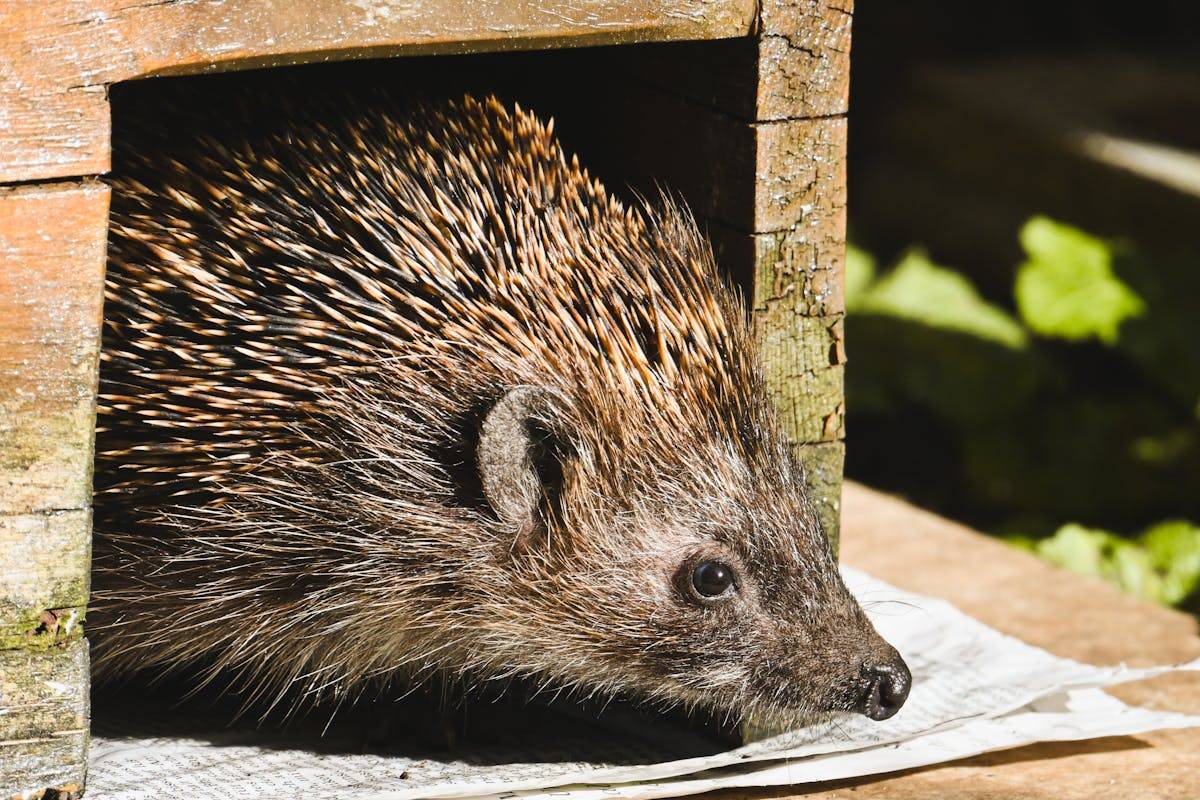
A hedgehog peeks out from its wooden shelter. Even a simple house can save a hedgehog’s life in winter. Photo: Alexas Fotos / Pexels.
For detailed building instructions, see our own SiiliSaari guide (siilisaari.fi), the Finnish Association for Nature Conservation (sll.fi) and WWF Finland (wwf.fi).
Do you know how to build a hedgehog house, and would you be willing to build them for others? Contact us — we will connect you with people who need help. Together, we can help the hedgehogs of the Vaasa region survive the winter.
Found an Injured Hedgehog?
A hedgehog needs help if it is staggering, lying still in the open, active in winter or visibly injured. Being out in daylight is also a warning sign, as healthy hedgehogs are nocturnal — though in summer a nursing mother may briefly forage by day. Fly eggs (which look like tiny grains of rice) or maggots on a hedgehog are an emergency. From late September onward, a hedgehog well under about 600 g is unlikely to survive Finland’s long hibernation without help. In late summer, however, small hedgehogs are often healthy juveniles: young born in midsummer weigh only about 120–350 g when they are weaned, usually in early August. Leave healthy hedgehogs alone, and don’t catch one just to weigh it. The law allows you to take in a hedgehog only if it is sick, injured or otherwise helpless, and only briefly — to give it first aid or to bring it in for treatment. If you are unsure, call us during our opening hours before picking it up. If the hedgehog does need help, here is what to do. First, put on thick gloves and place the hedgehog in a high-sided cardboard box lined with a towel. Next, provide warmth with a hot water bottle wrapped in a towel, leaving room in the box for the hedgehog to move away from it; a bottle left to go cold does more harm than good. If the hedgehog is bleeding or has fly eggs or maggots, don’t add heat — it needs a vet right away (see below). Don’t add heat in hot weather either. Once the hedgehog has warmed up, offer it water in a shallow dish and a little meaty cat food — never milk. Then call us at (06) 321 7300 and bring the hedgehog to Eläinklinikka Saari (Gerbyntie 18, Vaasa). We give it first aid, and SiiliSaari Care Center, the hedgehog rehabilitation center run by our clinic, takes over its ongoing care. We are open Monday–Friday 7:45–17:00. In the evening or on the weekend, keep the hedgehog in its box in a quiet place and bring it in when we open — but if it is bleeding, has fly eggs or maggots, or has collapsed, call the after-hours vet at 0600 399 299.

Left: a 420 g hedgehog; right: a 750 g hedgehog (phone for scale). From late September onward, a hedgehog well under 600 g is unlikely to survive hibernation without help, but in late summer small hedgehogs are often healthy juveniles. Photo: Eläinklinikka Saari.
Hedgehog Life in Brief
The hedgehog is nocturnal and travels about 1–2 km a night in search of food. Its back and sides are covered with some 5,000–7,000 spines. It feeds mainly on ground-dwelling invertebrates — beetles, caterpillars, earthworms, slugs and snails — which makes it a welcome guest in any garden. In Finland, hibernation usually lasts from about October to April or May. During hibernation, the hedgehog’s heart rate falls from about 190 to around 20 beats per minute, its body temperature drops from about 35°C to just a few degrees, and it lives on its fat reserves, losing a considerable part of its body weight. Finnish hedgehogs mate from May onward, and the young are born in midsummer, usually in litters of three to seven. In the wild, hedgehogs usually live two to three years. Advice on the minimum weight before hibernation varies. The British Hedgehog Preservation Society gives about 450 g as the absolute minimum, the Finnish animal welfare association SEY recommends at least about 600 g, and the Finnish Association for Nature Conservation (SLL) 800 g.